9 Simple Principles of Noorani Qaida
A Very Sweet and Easy Journey to Learn the Quran
I still remember the day when I first opened Noorani Qaida.
I was a little scared and a little happy.
The book was small.
It had big, colorful letters.
But I couldn’t understand anything.
I thought to myself:
“Will I ever be able to read the Quran correctly?”
Then my teacher smiled and said:
“Son, everything will come gradually.”
And indeed…
Today I understand that Noorani Qaida is not just a book,
it is the first door to learning the Quran.
What is Noorani Qaida?
Noorani Qaida is a book
that teaches us to read the Quran.
In it we are taught:
- How to read letters
- How to make sounds
- How to combine words
It is just like we first learn ABC,
Then we make words,
Then we read sentences.
A short story
There was a child, his name was Ahmed.
He wanted to read the Quran.
But when he opened the Quran,
He did not understand anything.
He became sad.
Then his mother said:
“First learn the Noorani Qaida.”
The first day he did not understand anything.
The second day was also difficult.
But he did not give up.
Slowly…
He started to recognize letters.
Then he started to make sounds.
Then he started to read words.
One day it happened
when he read a whole line of the Quran himself.
He was very happy.
And tears of joy came to his eyes.
This is the power of the Noorani Qaida.
Now let’s come to the 9 principles
1. Recognizing letters (the first step)
First of all, we learn the letters of Arabic.
For example:
الفباءتاثاثجيمحاخا
At first, they all look the same.
Children often say:
“They are all the same!”
But when we see them again and again,
we understand the difference.
It is just like:
Earlier, we also found A, B, C difficult.
What should we do?
- Read a little bit every day
- Repeat again and again
- Don’t rush
This is the foundation.
If this becomes strong
then everything will be easy in the future.
2. Pronouncing the correct sound (very important)
Now we learn how to pronounce the sound of the letters.
Each letter has its own place.
- Some letters come from the throat
- Some from the tongue
- Some from the lips
Example:
ع → from the throat
Q → from the deep throat
At first it seems difficult.
The children laugh.
But the teacher teaches again and again.
An important thing
If the sound is made wrong
The meaning of the word can change.
That is why it is very important.
3. Combining letters (the fun part)
Now we start combining letters.
For example:
با + الف = با
ميم + نون = من
First we read one letter at a time:
ب… ا
Then:
با
Then it gradually gets faster.
What does it feel like?
- It feels like we are learning something new
- As if we are learning in a game
4. Zabar, زير, پش (small but important)
These are small signs.
- Zabar (َ)
- Zir (ِ)
- Pesh (ُ)
These tell us:
How to pronounce the sound
Example:
بَ → با
بِ → بِ
بُ → بُ
These are very important.
If these are not
then we cannot read correctly.
5. Tanween (double sound)
Now we go a little further.
What is Tanween?
This is a double sound.
Example:
اً
ٍ
ٌ
Example:
كتابٌ
علمٍ
It mostly comes at the end of a word.
Initially, children get confused
But then it becomes easy.
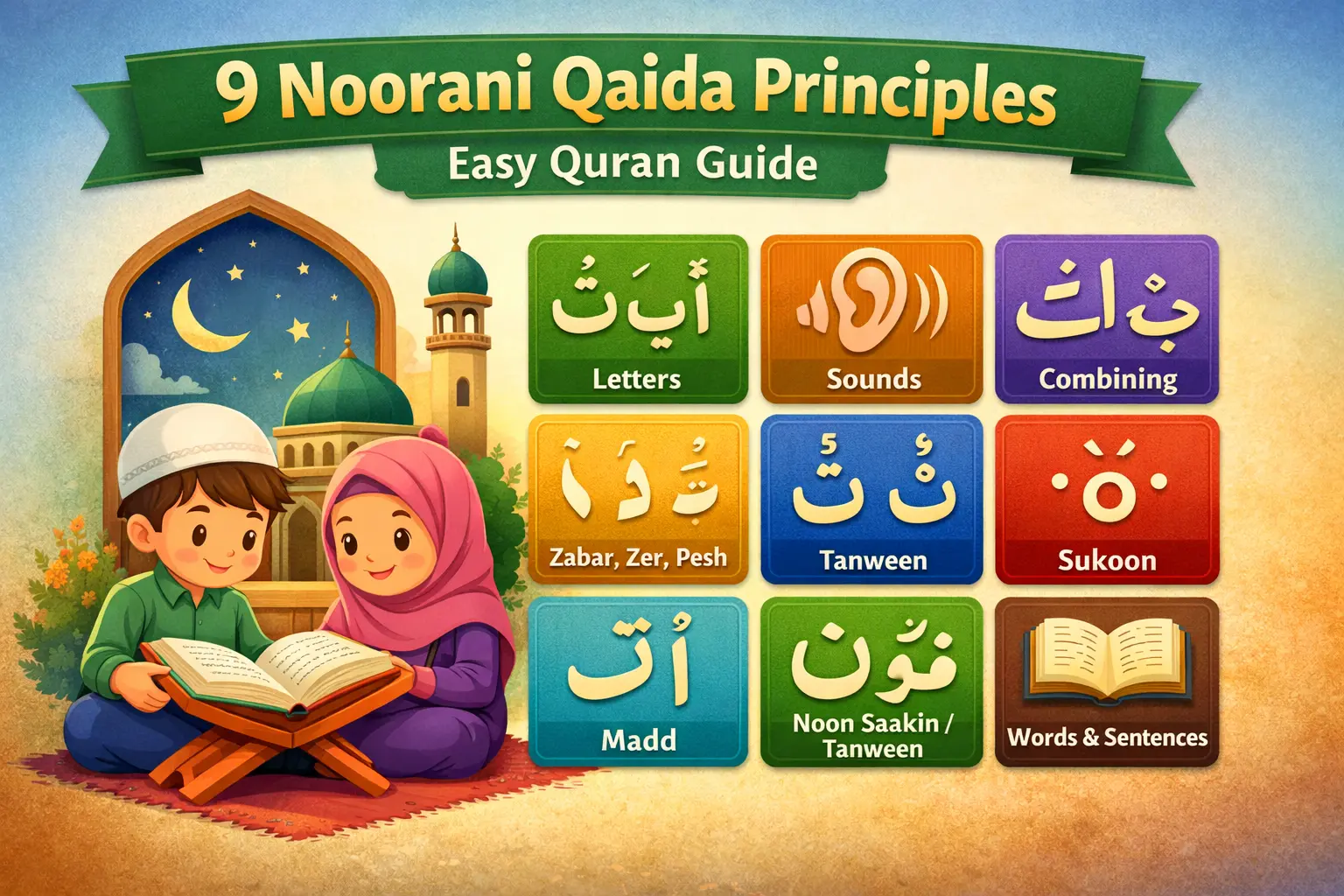
6. Sukoon (learning to stop)
Sukoon means: to stop
Sign: (ْ)
Example:
قل
من
عبد
It teaches us
where to stop
Why is it important?
If we do not stop at the right place
Then our reading gets spoiled
7.Mudd (stretching the sound)
Mudd means lengthening the sound
Example:
a → aa
o → ao
i → ai
Like:
ba → baa
bi → bii
It makes reading beautiful
When a child learns mudd
He enjoys it
8. Principles of Noon Saekin and Tanween
It seems a little difficult
But it is easy
They are of 4 types:
- Expression
- Ikhfa
- Idhumid
- Iqlab
At first it seems difficult
But the teacher explains with examples
What is the secret?
- Don’t rush
- Learn slowly
9. Reading words and sentences (the most enjoyable part)
Now everything is found
We read:
- Small words
- Then big ones
- Then sentences
When the child reads for the first time on his own
He is very happy
A feeling
“I can do it!”
Also Read: Hajj 2026: A Life-Changing Spiritual Journey to Makkah
Why is the Noorani Qaida important?
Many people start reading the Quran straight
But then they make mistakes
The Noorani Qaida teaches us:
- Correct reading
- Beautiful reading
- Reading with confidence
This is the foundation
A beautiful feeling
When you read the Qaida
The heart feels calm
There is silence
And you are only reading the words
It feels like you are getting closer to Allah
A message for children
If you are learning
Then never give up
It is difficult in the beginning
But it becomes easy later
Read a little every day
And read with a smile
A message for parents
Don’t scold children
Teach them with love
Congratulate them
Encourage them
The last thing
The Noorani Qaida is a small step
But it leads to a very big goal
It leads us to the Quran
And the Quran leads us to Paradise
May Allah grant us the ability to learn and understand the Quran
Ameen
FAQs
1. What are the rules of Noorani Qaida Tajweed?
Noorani Qaida Tajweed rules teach correct pronunciation of Arabic letters, proper use of vowels, stopping rules, and basic Tajweed like Madd, Sukoon, and Noon Saakin rules.
2. What are the principles of Tajweed?
The main principles of Tajweed are correct letter pronunciation (Makharij), characteristics of letters (Sifaat), and applying rules like elongation, merging, and stopping.
3. What are some of the fundamental principles in the Quran?
The Quran teaches belief in one God, following the Prophet, doing good deeds, being honest, patient, and kind to others.
4. What are the 4 rules of Tajweed?
The 4 main rules are:
Izhar (clear pronunciation)
Ikhfa (hidden sound)
Idgham (merging letters)
Iqlab (changing sound)
If you wish to learn the Quran online or enroll in one of our Quran courses, click below and start your learning journey today.
Explore Our Courses →