Eid ul Adha ke Fazail aur Masail: A Complete Islamic Guide
Eid ul Adha ke Fazail aur Masail
Eid ul Adha ke Fazail aur Masail (the virtues and rulings of Eid ul Adha) represent one of the most important topics every Muslim must understand deeply. This sacred occasion, celebrated on the 10th of Dhul Hijjah, is not simply a festival but a complete act of worship that combines Salah, Qurbani (sacrifice), remembrance of Allah, and care for the less fortunate. Millions of Muslims across the world observe this day with immense devotion, and those performing Hajj in Makkah make it even more spiritually charged for the entire Ummah.
In this comprehensive guide, we will cover everything related to Eid ul Adha ke Fazail aur Masail so that you can observe this blessed day in the most correct and rewarding manner.
What Is Eid ul Adha?
Eid ul Adha, also known as the “Festival of Sacrifice” or Baqra Eid in common Urdu usage, commemorates the extraordinary act of Prophet Ibrahim (AS) who was commanded by Allah to sacrifice his beloved son, Prophet Ismail (AS). Without hesitation, both father and son submitted to Allah’s command. In recognition of their complete obedience (farmabardari), Allah replaced Ismail (AS) with a ram from Jannah and made this act of sacrifice a lasting Sunnah for the Muslim Ummah until the Day of Judgment.
This event is the spiritual foundation of Eid ul Adha ke Fazail aur Masail and teaches Muslims the core lesson: true worship is complete submission to Allah, regardless of personal sacrifice.
Fazail (Virtues) of Eid ul Adha in the Light of Quran and Hadith
Quranic References
Allah Almighty says in Surah Al-Hajj (22:37):
“It is neither their meat nor their blood that reaches Allah, but it is your Taqwa (piety and God-consciousness) that reaches Him.”
This verse is the cornerstone of understanding Eid ul Adha ke Fazail aur Masail. The act of Qurbani is not about the physical sacrifice alone. It is about sincerity, intention, and closeness to Allah.
In Surah Al-Kawthar (108:2), Allah commands the Prophet (PBUH):
“So pray to your Lord and sacrifice.”
This divine command establishes that Eid ul Adha Salah and Qurbani are both obligatory acts of worship deeply connected to each other.
Hadith on the Virtues of Eid ul Adha
The Prophet Muhammad (PBUH) said:
“There is no deed that is dearer to Allah during the days of Eid ul Adha than the shedding of blood (i.e., offering sacrifice). The animal will come on the Day of Resurrection with its horns, hair, and hooves, and the blood reaches Allah before it even falls on the ground. So let your heart be at ease when you sacrifice.” (Tirmidhi, Ibn Majah)
In another narration, it is reported that the first drop of blood shed during Qurbani serves as a kaffarah (expiation) for the sins of the one who sacrifices. These narrations form the heart of Eid ul Adha ke Fazail aur Masail and show how immense the reward of this ibadah truly is.
The First Ten Days of Dhul Hijjah
Eid ul Adha falls within the most blessed ten days of the Islamic year. The Prophet (PBUH) said:
“There are no days on which righteous deeds are more beloved to Allah than these ten days (of Dhul Hijjah).” (Bukhari)
During these days, Muslims are encouraged to:
Perform extra Dhikr (remembrance of Allah), Takbeer, Tahleel, and Tahmeed. Keep optional fasts, especially on the 9th of Dhul Hijjah (the Day of Arafah). Give Sadaqah (charity) generously. Recite Quran abundantly and make sincere Tawbah (repentance).
The fast of the Day of Arafah expiates the sins of two years: the past year and the coming year. (Sahih Muslim)
Understanding these virtues is essential to fully appreciating Eid ul Adha ke Fazail aur Masail and acting on them throughout the entire month of Dhul Hijjah.
Masail (Rulings) of Eid ul Adha: A Fiqhi Guide
1. On Whom Is Qurbani Obligatory?
Qurbani is Wajib (obligatory) according to Imam Abu Hanifa on every Muslim who is:
- Sane (Aqil) and adult (Baligh)
- A resident, not a traveler (Muqeem)
- Owner of wealth equal to or above the Nisab (minimum threshold for Zakat)
According to Imam Shafi and Imam Malik, Qurbani is a confirmed Sunnah (Sunnat Muakkadah). One Qurbani per household covers the entire family, though additional Qurbanis are highly rewarding.
2. Valid Animals for Qurbani
Not every animal qualifies for sacrifice. The accepted animals and their minimum ages are:
- Goat or sheep: At least one year old (a six-month-old sheep that appears fully grown is also acceptable)
- Cow or buffalo: At least two years old
- Camel: At least five years old
One goat or sheep counts as Qurbani for one person. A cow, buffalo, or camel can cover up to seven people as partners.
3. Defects That Invalidate Qurbani
An animal with any of the following defects cannot be used for Qurbani:
Clearly blind in one or both eyes. So lame that it cannot walk to the slaughter place. So sick that its sickness is visibly apparent. Missing one-third or more of an ear, tail, or nose.
Minor blemishes do not invalidate Qurbani, but it is better to sacrifice a healthy, well-nourished animal.
4. Time of Qurbani
The time for Qurbani begins after the Eid Salah on the 10th of Dhul Hijjah and ends at sunset on the 12th of Dhul Hijjah. This gives Muslims three days to perform the sacrifice. Sacrificing before the Eid Salah is not valid and must be repeated.
It is Makrooh (disliked) to perform Qurbani at night, though it remains valid if done so.
5. Distribution of Qurbani Meat
The Sunnah method of distributing Qurbani meat is to divide it into three equal portions:
- One-third for the family
- One-third for relatives and friends
- One-third for the poor and needy
Selling the meat or giving it as wages to the butcher is not permissible. The butcher must be paid separately in cash
 .
.
Eid ul Adha Salah: Rules and Method
Time of Eid Salah
The Eid ul Adha Salah should be performed earlier than Eid ul Fitr Salah so that people can proceed to offer Qurbani after the prayer.
Method of Eid Salah
Eid Salah consists of two Rakats with six additional Takbeers (Zaid Takbeeraat). In the first Rakat, three extra Takbeers are said after Takbeer-e-Tahreemah and before the recitation of Surah Fatiha. In the second Rakat, three extra Takbeers are said before going into Ruku.
Takbeerat-e-Tashreeq
From the Fajr of the 9th Dhul Hijjah to the Asr of the 13th Dhul Hijjah, it is Wajib to recite the following Takbeer after every Fard Salah:
“Allahu Akbar, Allahu Akbar, La ilaha illallah, Wallahu Akbar, Allahu Akbar, Wa Lillahil Hamd.”
Men should recite it aloud and women should recite it softly.
Sunnah Acts of Eid ul Adha
To observe Eid ul Adha ke Fazail aur Masail in the most complete manner, the following Sunnah acts should be performed:
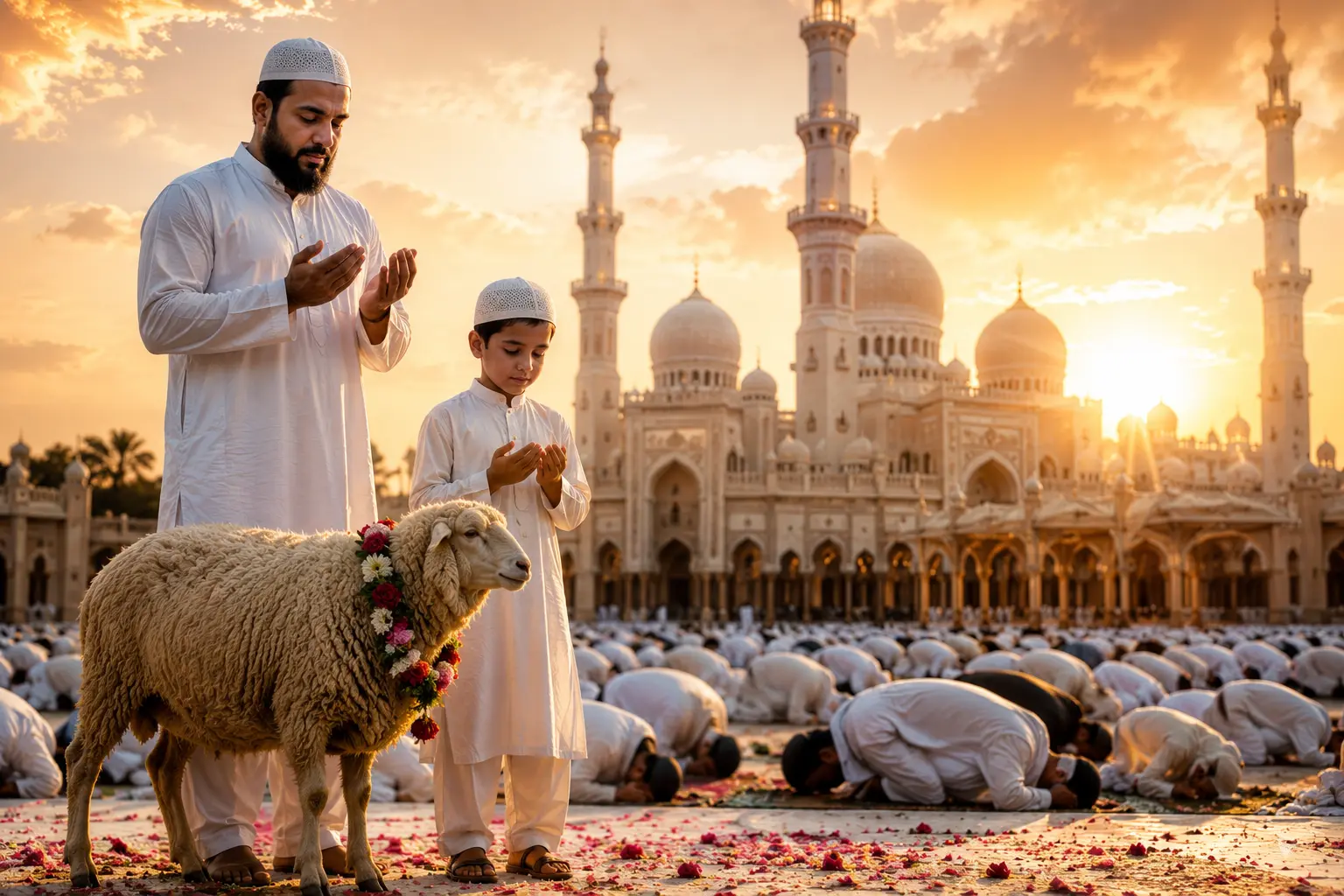
Perform Ghusl (full body bath) before going for Eid Salah. Wear clean and, if possible, new clothes. Refrain from eating anything before the Eid Salah so that the first food eaten is from the Qurbani meat. Walk to the Eid Gah (prayer ground) and return by a different route. Recite Takbeer loudly on the way to the prayer ground. Exchange greetings and congratulations with fellow Muslims.
Eid ul Adha and the Spirit of Hajj
Eid ul Adha ke Fazail aur Masail cannot be fully appreciated without understanding its connection to Hajj. On the Day of Arafah, millions of pilgrims gather at the plains of Arafat in one of the greatest displays of Muslim unity in history. The next day, the 10th of Dhul Hijjah, those pilgrims perform Rami (stoning of the devil), Qurbani, and Halq or Qasr (shaving or cutting of hair) in Mina, while Muslims worldwide celebrate Eid ul Adha and offer their own sacrifices.
This simultaneous act of worship across the globe is a powerful demonstration of the Ummah’s unity, brotherhood, and shared devotion to Allah.
Contemporary Masail of Eid ul Adha
Online or Agency-Based Qurbani
In today’s world, many Muslims living abroad or in urban areas arrange Qurbani through trusted Islamic organizations or online platforms. Scholars have ruled this permissible provided the organization is reliable, the sacrifice is performed within the valid time, and the correct conditions of Qurbani are met.
Storing Qurbani Meat
There is a scholarly consensus that storing Qurbani meat in freezers for future use is permissible. An earlier prohibition on storing meat beyond three days was later lifted by the Prophet (PBUH) himself when the need arose.
Giving Money Instead of Animal
It is not permissible to simply give the monetary value of an animal as a replacement for Qurbani. The physical sacrifice of a qualifying animal is a condition of the act itself.
The Social Dimension of Eid ul Adha
Beyond the individual spiritual benefits, Eid ul Adha ke Fazail aur Masail also highlight the social responsibility embedded in this ibadah. By distributing Qurbani meat to neighbors, relatives, and those in need, Muslims create bonds of love and eliminate economic inequality for at least a few days. Orphans, widows, and poor families get access to quality food that many of them cannot afford otherwise. This social impact makes Qurbani not just a personal act of worship but a community-building institution.
Also Read: Qurbani Ke Ahkam: Complete Rules, Virtues, and Masail
Conclusion
A thorough understanding of Eid ul Adha ke Fazail aur Masail equips every Muslim to observe this great occasion with the reverence it deserves. From its Quranic foundations and prophetic narrations to the detailed fiqhi rulings on Qurbani, Salah, and distribution of meat, this day encompasses worship, sacrifice, community, and gratitude all at once. Following the Sunnah of Prophet Ibrahim (AS) and the guidance of our beloved Prophet Muhammad (PBUH), let us offer our Qurbani with complete sincerity, pray our Eid Salah with full attention, and share the blessings of this day with everyone around us. May Allah accept our sacrifices, forgive our sins, and grant us the true spirit of Eid ul Adha ke Fazail aur Masail. Ameen.
Frequently Asked Questions (FAQs)
Q1: What is the meaning of Eid ul Adha ke Fazail aur Masail?
It refers to the virtues (fazail) and Islamic rulings (masail) related to Eid ul Adha, covering the significance, worship acts, and legal guidelines of this blessed day.
Q2: When is Eid ul Adha celebrated?
Eid ul Adha is observed on the 10th of Dhul Hijjah every year according to the Islamic lunar calendar.
Q3: On whom is Qurbani obligatory?
Qurbani is obligatory on every sane, adult, resident Muslim who possesses wealth equal to or above the Nisab threshold.
Q4: How many people can share one cow for Qurbani?
Up to seven people can share one cow, buffalo, or camel for Qurbani.
Q5: Can Qurbani meat be sold?
No, selling Qurbani meat or giving it as payment to the butcher is not permissible.
Q6: What is the time period for performing Qurbani?
Qurbani can be performed from after Eid Salah on the 10th of Dhul Hijjah until sunset on the 12th of Dhul Hijjah.
Q7: What is the fast of the Day of Arafah?
Fasting on the 9th of Dhul Hijjah expiates the sins of the past and coming year. (Sahih Muslim)
Q8: Can a woman perform Qurbani herself?
Yes, a woman can perform Qurbani herself or appoint someone else as her wakeel (representative) to do it on her behalf.
