How to Find Qibla Direction Anywhere in the World

How to Find Qibla Direction
Every Muslim who prays five times a day faces one common requirement: knowing the exact direction of the Kaaba in Mecca, Saudi Arabia. This direction is called the Qibla, and facing it correctly during Salah is a condition of a valid prayer in Islam. Whether you are at home, traveling, in a hotel room, or standing in an unfamiliar city, learning how to find Qibla direction is a skill every believer should have.
In this guide, we will walk through the most reliable methods for locating the Qibla, from modern smartphone apps to traditional techniques using the sun and stars. By the end, you will understand not only how to find Qibla direction accurately but also why these methods work and what to do when technology is not available.
What Is Qibla and Why Does It Matter
The word Qibla refers to the direction Muslims face while performing Salah. This direction always points toward the Kaaba, the cube shaped structure located at the center of the Masjid al Haram in Mecca. The Kaaba is considered the holiest site in Islam and serves as the spiritual focal point for prayer across the globe.
Facing the Qibla is rooted in the Quran, where Allah instructs believers to turn their faces toward the Sacred Mosque. This command created a unified direction of worship for Muslims regardless of where they live, whether in Karachi, London, Jakarta, or New York. Because the Kaaba is a fixed geographic point, the Qibla direction changes depending on your location on Earth, which is why calculating it correctly matters so much.
Method 1: Using a Qibla Compass App
The fastest and most accessible way to find Qibla direction today is through a dedicated Qibla compass app on your smartphone. These apps use your device’s GPS location along with its built in magnetic sensor to calculate the shortest angle between your position and the Kaaba’s coordinates.
Popular apps such as Muslim Pro, Qibla Finder, and Al Moazin allow you to simply hold your phone flat, and an arrow or line will point directly toward Mecca. Some apps also show the exact degree reading, which can be cross checked with a physical compass for added accuracy.
To use a Qibla app correctly:
- Enable location services so the app can detect your precise coordinates.
- Calibrate the compass sensor by moving your phone in a figure eight motion if prompted.
- Hold the device flat and level, away from metal objects or electronics that may interfere with the magnetic reading.
- Wait for the arrow to stabilize before confirming your direction.
This method works well in most modern cities, though magnetic interference from steel buildings, elevators, or electrical wiring can occasionally throw off the reading, so a second method is always useful as a backup.
Method 2: Using Google Maps or Google Earth
Another dependable way to find Qibla direction is by using satellite mapping tools. Google Maps and Google Earth allow you to draw a straight line between your location and the Kaaba, giving you a visual bearing you can then match with a compass.
Here is how it works:
- Search for your current location on Google Earth.
- Search separately for the Kaaba in Mecca, which has fixed coordinates near 21.4225 degrees North latitude and 39.8262 degrees East longitude.
- Use the ruler or measuring tool to draw a line connecting the two points.
- Note the bearing angle displayed, which tells you the direction in degrees from true north.
This method is particularly useful for architects, mosque builders, and travelers who want a precise reference point before relying on a phone app.
Method 3: Using a Traditional Magnetic Compass
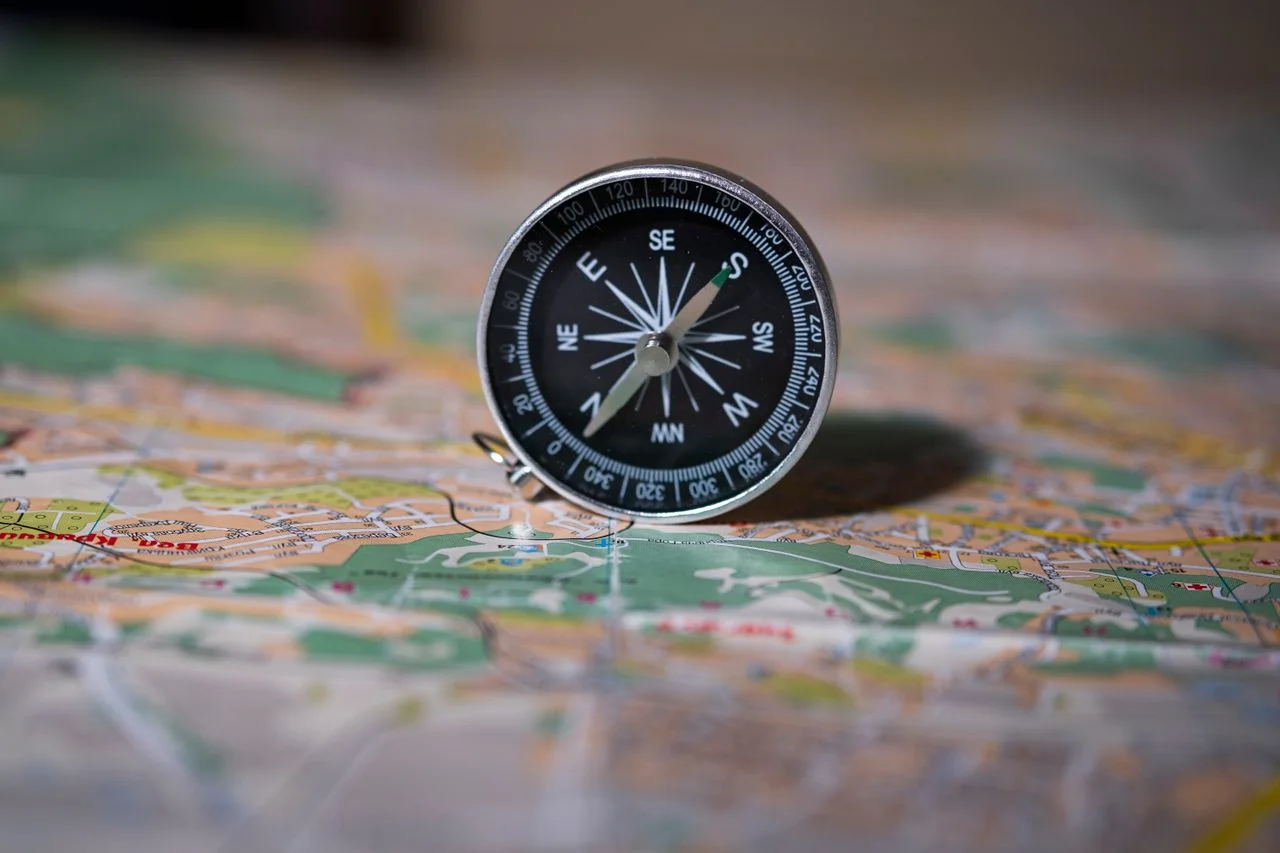
Before smartphones, Muslims relied on the humble magnetic compass paired with mathematical calculations. If you know the Qibla bearing for your city, which is often published by local Islamic centers or mosque authorities, you can use a standard compass to find the direction manually.
Simply hold the compass flat, allow the needle to settle on magnetic north, and then rotate your body until you align with the known bearing angle for your location. For example, cities in North America often have a Qibla direction pointing northeast, while cities in South Asia typically point west or northwest, since the angle depends entirely on your position relative to Mecca.
Keep in mind that a magnetic compass points to magnetic north, not true north, and there is a difference between the two called magnetic declination. In most everyday prayer situations this small variation is not significant, but for precise mosque construction, declination should be factored into the final calculation.
Method 4: Using the Sun and Shadow Method
Long before compasses and satellites, Muslim scholars and astronomers developed a method based on the sun’s position, which remains remarkably accurate even today. Twice a year, the sun passes directly over the Kaaba at solar noon, meaning any shadow cast at that exact moment points away from Mecca, giving a perfect reference for the Qibla.
This phenomenon occurs around May 27 or 28 and again around July 15 or 16 each year, when the sun reaches its zenith directly above the Kaaba’s coordinates. At that specific time, anyone standing outdoors anywhere in the world experiencing daylight can observe the sun’s shadow and use it to align their prayer direction with remarkable precision.
Astronomy based Qibla calculation is also used by scholars who compute the direction using spherical trigonometry, factoring in latitude and longitude to determine the great circle route to Mecca. This is the same mathematical model that modern Qibla apps rely on behind the scenes.
Method 5: Using the North Star (Polaris)
In the northern hemisphere, Polaris, commonly known as the North Star, can serve as a helpful reference point at night. Since Polaris sits almost directly above the North Pole and barely moves in the sky, it has been used by sailors and travelers for centuries as a fixed marker for true north.
Once you locate true north using Polaris, you can rotate to the known Qibla bearing angle for your city, similar to the compass method described earlier. This technique is especially useful in remote areas without internet access or GPS signal, such as during camping trips or long desert journeys.
Also Read: Are You Making These Common Mistakes in Wudu? (Most Muslims Do)
Common Mistakes When Finding Qibla Direction
Even with modern tools, a few errors can lead to an inaccurate Qibla reading:
- Holding a smartphone near metal furniture, laptops, or speakers, which distorts the compass sensor.
- Forgetting to calibrate the phone’s compass before use, resulting in a delayed or inaccurate arrow.
- Confusing magnetic north with true north when using a manual compass without adjusting for declination.
- Relying on outdated printed Qibla charts that were calculated using less precise coordinates for the Kaaba.
- Assuming the Qibla direction is the same for every country in a region, when in reality it can vary meaningfully even within the same city depending on exact location.
Being aware of these pitfalls will help you achieve a far more reliable result whenever you calculate the Qibla.
Why Accuracy Matters in Salah
Islamic scholars generally agree that facing the general direction of the Kaaba, rather than an exact pinpoint angle, is sufficient for a valid prayer, especially when praying far from Mecca. This concept is known as jihat al Kaaba, meaning the direction toward the Kaaba rather than an exact line. However, striving for the most accurate direction possible remains a recommended practice, particularly for mosque construction, where architects and engineers aim for precise alignment using surveying equipment and geographic calculations.
For daily personal prayer, using any of the methods described above, whether a Qibla app, compass, or sun based calculation, will give you a direction that is more than sufficiently accurate according to mainstream Islamic scholarship.
Final Thoughts
Learning how to find Qibla direction does not require advanced tools or deep technical knowledge. From smartphone apps and satellite maps to the ancient wisdom of shadow tracking and star navigation, Muslims today have more reliable options than any generation before them. Whichever method you choose, the goal remains the same: facing the Kaaba with sincerity and focus during your daily prayers, wherever in the world you happen to be standing.
Frequently Asked Questions
What is the easiest way to find Qibla direction?
The easiest method is using a Qibla compass app on your smartphone, since it automatically detects your location and points toward Mecca using GPS and magnetic sensors.
Does Qibla direction change depending on location?
Yes, the Qibla direction is different for every location on Earth because it depends on the angle between your specific coordinates and the fixed position of the Kaaba in Mecca.
Can I use a regular compass to find Qibla?
Yes, a regular magnetic compass can be used if you already know the Qibla bearing angle for your city, which is often available from local mosques or Islamic organizations.
What is the sun method for finding Qibla?
The sun method relies on the fact that the sun passes directly over the Kaaba around May 27 or 28 and July 15 or 16 each year, allowing anyone in daylight to use the shadow cast at that exact moment as a Qibla reference.
Is it necessary to face the exact Qibla angle for prayer to be valid?
Most scholars agree that facing the general direction of the Kaaba is sufficient for a valid prayer, especially for those praying far from Mecca, though precise alignment is encouraged when possible.
If you wish to learn the Quran online or enroll in one of our Quran courses, click below and start your learning journey today.
Explore Our Courses →
