Life of Prophet Muhammad (PBUH): A Complete Journey From Birth to Legacy
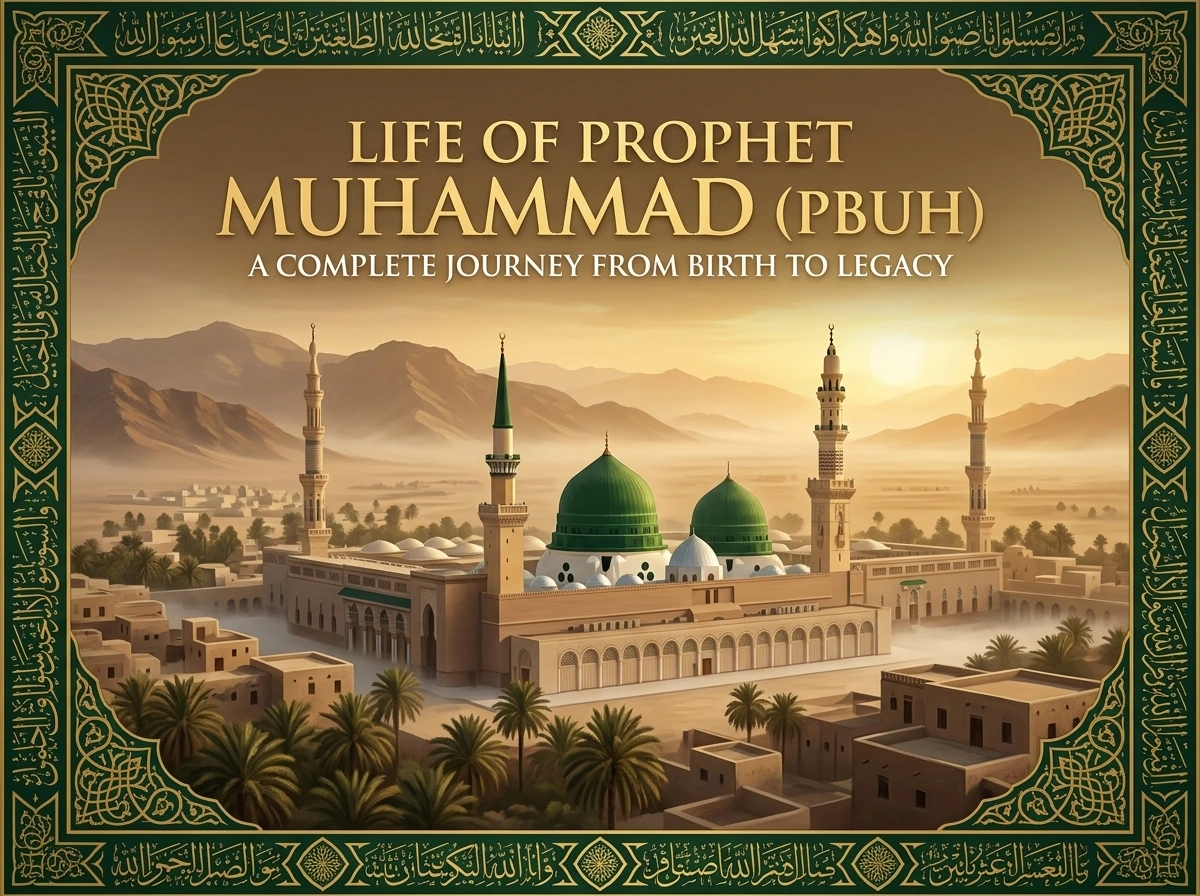
Life of Prophet Muhammad (PBUH): A Complete Journey From Birth to Legacy
One Man, One Message, and a World That Was Never the Same Again
Imagine an orphan born in a small desert town, raised without wealth or political power. Within twenty-three years, that same man would unite a divided land, transform the moral compass of a civilization, and leave a message that more than a billion people follow today.
This is not a myth or a legend. It is the documented life of Prophet Muhammad (PBUH), preserved in the Quran, authentic hadith collections, and detailed biographical works written by early Muslim scholars.
Introduction: Why Studying the Life of Prophet Muhammad (PBUH) Still Matters
The life of Prophet Muhammad (PBUH) is the most thoroughly recorded biography of any religious founder in history. We know the names of his companions, the details of his daily habits, the words he spoke in times of joy and grief, and the decisions he made at every turning point.
This article walks through his life in chronological order, from his birth in Makkah to his passing in Madinah. Along the way, we will look at the character traits that shaped his mission and the practical lessons readers can apply in their own lives.
A quick note on reading approach. Most scholars recommend reading the Seerah (the biography of the Prophet) in order, because each phase explains the next. Skipping ahead to the battles or the Hijrah without understanding the years of patience in Makkah often leads to misunderstanding.
What you will learn in this guide:
- The setting of Arabia before his birth
- His childhood, youth and marriage to Khadijah (may Allah be pleased with her)
- The first revelation and the years of persecution in Makkah
- The Hijrah and the founding of the first Muslim community in Madinah
- Major events, treaties and the conquest of Makkah
- His character, family life and final days
- Practical lessons for modern readers
Arabia Before the Prophet: The World He Was Born Into
To appreciate the life of Prophet Muhammad (PBUH), we first need to understand the society around him. Seventh-century Arabia was largely tribal, and loyalty to the clan often mattered more than justice or truth.
Makkah was a trading hub and home to the Kaaba, originally built by Prophet Ibrahim and his son Ismail (peace be upon them). Over time, the Kaaba had become surrounded by idols, and many Arabs had drifted away from the pure monotheism of Ibrahim.
Common social realities of that era included:
- Frequent tribal feuds that could last for generations
- Weak protection for orphans, widows and the poor
- Widespread idol worship alongside a small number of people who still sought the one true God
- Unequal treatment of women and slaves in many households
This was the setting into which the final Messenger was born.
Birth and Early Childhood in Makkah
The Year of the Elephant
Prophet Muhammad (PBUH) was born in Makkah in the Year of the Elephant, around 570 CE, a year remembered for the failed attack on the Kaaba by Abraha and his army. Most historians place his birth on a Monday in the month of Rabi al-Awwal, with the 12th being the most widely cited date.
His father, Abdullah ibn Abdul Muttalib, passed away before he was born. His mother was Aminah bint Wahb, from the clan of Banu Zuhrah.
Years With Halimah and the Bedouins
It was a custom among noble Makkan families to send newborns to the desert so that they would grow up healthy and learn pure Arabic. The infant Muhammad (PBUH) was cared for by Halimah al-Sa’diyyah of the Banu Sa’d tribe.
He returned to his mother at around the age of five. These early years in the open desert shaped his clear speech and physical strength.
Loss After Loss
When he was about six, his mother Aminah passed away on the journey back from Madinah, at a place called Al-Abwa. He was then cared for by his grandfather, Abdul Muttalib, who died only two years later.
Custody then passed to his uncle Abu Talib, who protected and supported him for decades. This early experience of loss helps explain the deep compassion he showed toward orphans throughout his life.
Youth and Early Adulthood: The Trustworthy One
Work, Travel and Reputation
As a young man, Muhammad (PBUH) worked as a shepherd and later as a trader. According to the classical biographies, he traveled to Syria with Abu Talib as a boy and later led trade caravans there on behalf of others.
What set him apart was his integrity. The people of Makkah gave him the titles Al-Amin (the trustworthy) and As-Sadiq (the truthful), even before prophethood.
Marriage to Khadijah (may Allah be pleased with her)
At about 25, he married Khadijah bint Khuwaylid, a respected and successful businesswoman who had been impressed by his honesty. Their marriage lasted around 25 years, and she remained his closest supporter until her death.
Together they had children, including Zaynab, Ruqayyah, Umm Kulthum, Fatimah and sons who passed away in early childhood. Their home is often described by scholars as a place of deep trust and mutual respect.
The Fair Resolution at the Kaaba
When he was around 35, the tribes of Makkah argued bitterly over who should have the honor of placing the Black Stone during the rebuilding of the Kaaba. Conflict seemed unavoidable.
Muhammad (PBUH) placed the stone on a cloak and asked each tribe’s leader to lift a corner together. This simple and wise solution prevented bloodshed and showed his gift for peacemaking.
The First Revelation: The Turning Point of His Life
The Cave of Hira
In his later years of youth, Muhammad (PBUH) often retreated to the Cave of Hira on Jabal al-Nour to reflect. It was there, in the month of Ramadan around 610 CE, when he was about 40 years old, that the angel Jibreel (Gabriel) appeared to him.
The first revelation was the command to read, found at the beginning of Surah Al-Alaq. He returned home shaken, and Khadijah comforted him by reminding him of his lifelong honesty, kindness and generosity.
The Message of Tawheed
The core of his message was simple and powerful: worship one God alone, uphold justice, care for the weak, and prepare for accountability on the Day of Judgment. The Quran continued to be revealed gradually over roughly 23 years.
The earliest believers included:
- Khadijah, the first to accept Islam
- Ali ibn Abi Talib, then a young boy in his household
- Abu Bakr as-Siddiq, his closest friend
- Zayd ibn Harithah, his freed servant and adopted son in the pre-Islamic sense
The Makkan Period: Patience Under Persecution
Three Years of Quiet Invitation
For roughly three years, the message was shared privately with trusted people. Then he was commanded to proclaim it openly, and he stood on Mount Safa to call the Quraysh to the worship of one God.
Many leaders rejected the call. Accepting it meant challenging their religion, their trade interests and their social status.
Hardship and Boycott
The Muslims, especially those without tribal protection, faced harassment, torture and economic pressure. Some companions such as Bilal ibn Rabah, Sumayyah and Yasir (may Allah be pleased with them) endured severe abuse for their faith.
When the Quraysh could not stop the message, they imposed a social and economic boycott on the Prophet’s clan, Banu Hashim, that lasted around three years. Families survived on very little in the valley known as Shi’b Abi Talib.
The Year of Sorrow
Shortly after the boycott ended, both Khadijah and Abu Talib passed away within a short span. This period is known as the Year of Sorrow (Aam al-Huzn), and it left the Prophet (PBUH) without his two greatest earthly supporters.
He then traveled to Ta’if hoping for support, but was rejected and pelted with stones. Even then, according to the well-known narration, he refused the offer to have the city destroyed and instead prayed that their descendants might believe.
Isra and Mi’raj
During these hard years, Allah honored him with the miraculous night journey from Makkah to Jerusalem (Isra) and the ascension through the heavens (Mi’raj). It was during this event that the five daily prayers were prescribed.
The Hijrah: A Migration That Changed History
The Pledges of Aqabah
During the pilgrimage seasons, a group of people from Yathrib (later called Madinah) met the Prophet (PBUH) and accepted Islam. They pledged to protect him, and a second, larger pledge followed the next year.
Muslims in Makkah began migrating to Madinah in small groups to avoid detection.
The Journey in 622 CE
When the Quraysh plotted to eliminate him, the Prophet (PBUH) left Makkah with Abu Bakr and hid in the Cave of Thawr for three days before continuing to Madinah. The Quran refers to this moment of trust in Allah during the cave episode.
This migration, known as the Hijrah, was so significant that the Islamic calendar begins from it.
Building the Community in Madinah
The Foundations
Upon arrival, one of his first actions was to build Masjid an-Nabawi, which served as a place of worship, education and community gathering. He also established bonds of brotherhood between the migrants (Muhajirun) and the local helpers (Ansar).
The Charter of Madinah
The Prophet (PBUH) established a founding agreement, often called the Constitution of Madinah, which outlined rights and responsibilities among Muslims, Jews and other tribes in the city. It is widely studied as an early example of a pluralistic community charter.
Key principles reflected in this period:
- Mutual protection and shared defense
- Freedom of belief for different groups
- Justice as a duty of the community
- Care for the poor through charity and organized support
Key Events in the Madinan Years
The life of Prophet Muhammad (PBUH) in Madinah included defensive conflicts and diplomatic milestones. Understanding the context of each event helps avoid the common mistake of reading them in isolation.
- Battle of Badr (2 AH): A decisive early encounter where a smaller Muslim force faced the Makkan army.
- Battle of Uhud (3 AH): A difficult lesson about discipline and obedience to instructions.
- Battle of the Trench (5 AH): The Muslims defended Madinah by digging a trench, a strategy suggested by Salman al-Farisi.
- Treaty of Hudaybiyyah (6 AH): A peace agreement that seemed unfavorable at first but opened the door to wide acceptance of Islam.
- Conquest of Makkah (8 AH): The Prophet (PBUH) entered the city with minimal bloodshed and granted general amnesty to his former persecutors.
The Remarkable Forgiveness at Makkah
When he returned to Makkah in victory, the people who had tortured and exiled him expected harsh punishment. Instead, he declared a general amnesty, echoing the words of Prophet Yusuf to his brothers.
This moment is often cited as one of the clearest demonstrations of his mercy in authority.
Also Read: Quran Recitation Classes: How to Choose, What to Expect, and How to Truly Improve

The Character of the Prophet (PBUH)
The Quran describes him as a mercy to all the worlds and as someone of exalted moral character. His companions repeatedly described him as gentle, truthful, humble and fair.
Qualities consistently reported in authentic sources:
- Honesty: Trusted even by his opponents before and after prophethood
- Mercy: Kind to children, animals, the elderly and the vulnerable
- Humility: He mended his own clothes and helped with household work
- Patience: He endured years of abuse without seeking revenge
- Justice: He insisted on fairness regardless of status or lineage
- Generosity: He rarely refused a person who asked for help
Family Life
He was a husband, father and grandfather who showed affection openly. He was known to play with his grandchildren Hasan and Husayn and to treat his daughter Fatimah with great love and respect.
His household was simple, and he often lived with very modest food and furnishings despite leading an entire community.
The Farewell Pilgrimage and Final Days
In 10 AH, the Prophet (PBUH) performed his only complete Hajj, known as the Farewell Pilgrimage. On the plains of Arafah, he delivered a sermon addressed to tens of thousands of followers.
Core themes of the Farewell Sermon:
- The sanctity of life, property and honor
- The rights of women and the duty to treat them well
- The equality of all people, with no superiority of one race over another except through piety
- The prohibition of interest-based exploitation and blood feuds
- Holding firmly to the Quran and his teachings
Soon after returning to Madinah, he fell ill. He passed away in 11 AH (632 CE), at the age of 63, in the home of his wife Aishah (may Allah be pleased with her). Abu Bakr became the first caliph, and the message he had carried continued to spread.
Practical Lessons From the Life of Prophet Muhammad (PBUH)
Studying his biography is not only a historical exercise. It offers practical guidance that remains relevant today.
- Build trust before anything else. His honesty earned him respect long before his mission began.
- Respond to hardship with patience and purpose. Thirteen years in Makkah show that long-term goals require resilience.
- Seek consultation. He regularly asked his companions for advice, as seen at Badr and the Trench.
- Forgive when you have the power to punish. The conquest of Makkah remains a timeless model.
- Balance worship and responsibility. He prayed through the night, yet also served his family and community.
- Care for the vulnerable. Orphans, widows, slaves and the poor were central to his teachings.
How to Study the Seerah Effectively
Based on common advice from scholars and long-time readers of the Seerah, a few habits make the study more rewarding:
- Start with a reliable and well-sourced biography
- Read the relevant Quranic verses alongside each event
- Take brief notes on lessons, not just dates
- Distinguish between authentic narrations and weak or fabricated stories
- Reflect on one practical action to apply after each chapter
Conclusion: A Life Worth Knowing
The life of Prophet Muhammad (PBUH) is a story of trust, patience, courage and mercy. From a childhood marked by loss to a legacy that shaped history, every stage offers guidance for individuals, families and communities.
The best way to honor his legacy is not only to learn the timeline, but to carry his character into daily life. Start with honesty in your words, kindness in your home, and justice in your dealings, and let the Seerah guide your next step.
Sources and Official References
- The Holy Quran: https://quran.com
- Sahih al-Bukhari: https://sunnah.com/bukhari
- Sahih Muslim: https://sunnah.com/muslim
- Jami at-Tirmidhi: https://sunnah.com/tirmidhi
- Shama’il al-Muhammadiyyah: https://sunnah.com/shamail
- Sirat Ibn Hisham (based on Ibn Ishaq), English translation by A. Guillaume, Oxford University Press: https://oup.com.pk/academic-generalbooks/biographies-memoirs/the-life-of-muhammad.html
Frequently Asked Questions
1. When and where was Prophet Muhammad (PBUH) born?
He was born in Makkah, in the Year of the Elephant, around 570 CE. Most scholars place his birth on a Monday in Rabi al-Awwal, commonly dated to the 12th.
2. How old was Prophet Muhammad (PBUH) when he received the first revelation?
He was about 40 years old when the angel Jibreel brought the first revelation in the Cave of Hira during Ramadan, around 610 CE.
3. What is the Hijrah and why is it important in the life of Prophet Muhammad (PBUH)?
The Hijrah was the migration from Makkah to Madinah in 622 CE. It marked the beginning of an organized Muslim community and is the starting point of the Islamic calendar.
4. How many children did Prophet Muhammad (PBUH) have?
According to the classical sources, he had several children, including Qasim, Abdullah, Zaynab, Ruqayyah, Umm Kulthum, Fatimah and Ibrahim. All but Fatimah passed away during his lifetime.
5. At what age did Prophet Muhammad (PBUH) pass away?
He passed away in Madinah in 11 AH (632 CE) at the age of 63, after a short illness.
Disclaimer: This article is provided for educational and informational purposes only and reflects general Islamic scholarly perspectives on Surah Yaseen. It is not a substitute for guidance from a qualified Islamic scholar or certified religious authority. For matters of hadith authenticity, personal practice, or specific religious rulings, please consult a certified professional in Islamic studies.
