Learn Arabic Online: The Complete Roadmap That Actually Works in 2026
Learn Arabic Online
Why Do So Many People Quit Arabic in the First Month?
Most people do not quit because Arabic is impossible. They quit because they start without a map. They download five apps, watch random videos, memorize a few phrases, and then stall when nothing connects.
If you want to learn Arabic online and stay consistent, you need a clear order of steps, realistic expectations, and a daily habit you can actually keep. This guide gives you all three.
Introduction
Arabic is one of the most rewarding languages you can study. It opens the door to a rich literary heritage, a huge media world, and conversations with hundreds of millions of people across more than twenty countries.
The good news is that you no longer need to live abroad or sit in a classroom to make real progress. When you learn Arabic online, you can study at any hour, repeat audio as many times as you need, and mix free and paid tools to fit your budget.
The challenge is knowing where to begin. This article walks you through what Arabic really is, how long it takes, a step-by-step roadmap, common mistakes, and a weekly plan you can start today.
Why It Is a Great Time to Learn Arabic Online
Online learning has changed how languages are acquired. Native speakers now publish audio, video, and written content every day, and you can access it from your phone.
Here is what makes online study so effective for Arabic:
- Flexibility: You can study on a commute, during a lunch break, or late at night.
- Unlimited repetition: Arabic sounds are new to many learners, and replaying audio is one of the fastest ways to train your ear.
- Variety of accents: You can hear Gulf, Levantine, Egyptian, and Maghrebi speech without leaving home.
- Low cost: Many high-quality materials are free, and paid options are usually cheaper than in-person programs.
- Progress tracking: Most digital tools show streaks, word counts, and review schedules.
Arabic is also one of the six official languages of the United Nations, which reflects its global weight in diplomacy, trade, and culture. That is a strong reason to invest your time.
Understand What You Are Learning: The Three Layers of Arabic
This is the single biggest source of confusion for beginners. “Arabic” is not one uniform spoken language. It works in layers, and knowing the difference saves you months of frustration.
Classical Arabic
Classical Arabic is the language of early Arabic literature and the Quran. It is studied for religious, historical, and literary reasons and is not used in everyday conversation.
Modern Standard Arabic (MSA)
MSA is the formal written standard used across the Arab world. You will find it in news broadcasts, books, newspapers, official documents, and speeches.
MSA is understood almost everywhere, but people rarely use it to chat with friends or family.
Spoken Dialects
Daily life happens in dialects. Egyptian, Levantine (Syrian, Lebanese, Palestinian, Jordanian), Gulf, Iraqi, and Maghrebi Arabic all differ in vocabulary, pronunciation, and rhythm.
Dialects can differ enough that speakers from distant regions may struggle to understand each other at first.
Which One Should You Start With?
Match your goal to the layer:
- Reading, news, formal writing, or academic work: Start with MSA.
- Travel, friendships, family, or work in a specific country: Start with the dialect of that region, then add MSA later.
- Religious texts: Begin with the alphabet and core vocabulary, then move toward the classical forms.
Many experienced learners recommend building an MSA foundation first and adding one dialect on top. That path gives you both reading ability and conversation, though it takes longer.
How Long Does It Take to Learn Arabic Online?
Honesty matters here. Arabic is considered one of the harder languages for English speakers. The U.S. Foreign Service Institute places it in its most demanding category and estimates roughly 2,200 hours of study to reach professional working proficiency.
That number sounds scary, but it describes advanced professional fluency. You can reach useful milestones much sooner.
A rough, realistic timeline for steady study:
- First 2 to 4 weeks: Read and write the alphabet and recognize basic sounds.
- 3 months: Handle greetings, introductions, numbers, and simple sentences.
- 6 to 9 months: Hold short, slow conversations on familiar topics.
- 1 to 2 years: Read simple articles and follow slow native audio with effort.
These figures vary a lot. Your native language, study time, and consistency all change the outcome. Thirty focused minutes every day usually beats three hours once a week.
Also Read: Life of Prophet Muhammad (PBUH): A Complete Journey From Birth to Legacy
A Step-by-Step Roadmap to Learn Arabic Online
Follow these steps in order. Each one builds the foundation for the next.
Step 1: Set a Clear Goal
Before opening any app, write one sentence that explains why you are learning. For example: “I want to hold a 10-minute conversation in Levantine Arabic by next summer.”
A specific goal tells you which layer of Arabic to study and which skills to prioritize. It also keeps you going when motivation dips.
Step 2: Master the Alphabet and Sounds
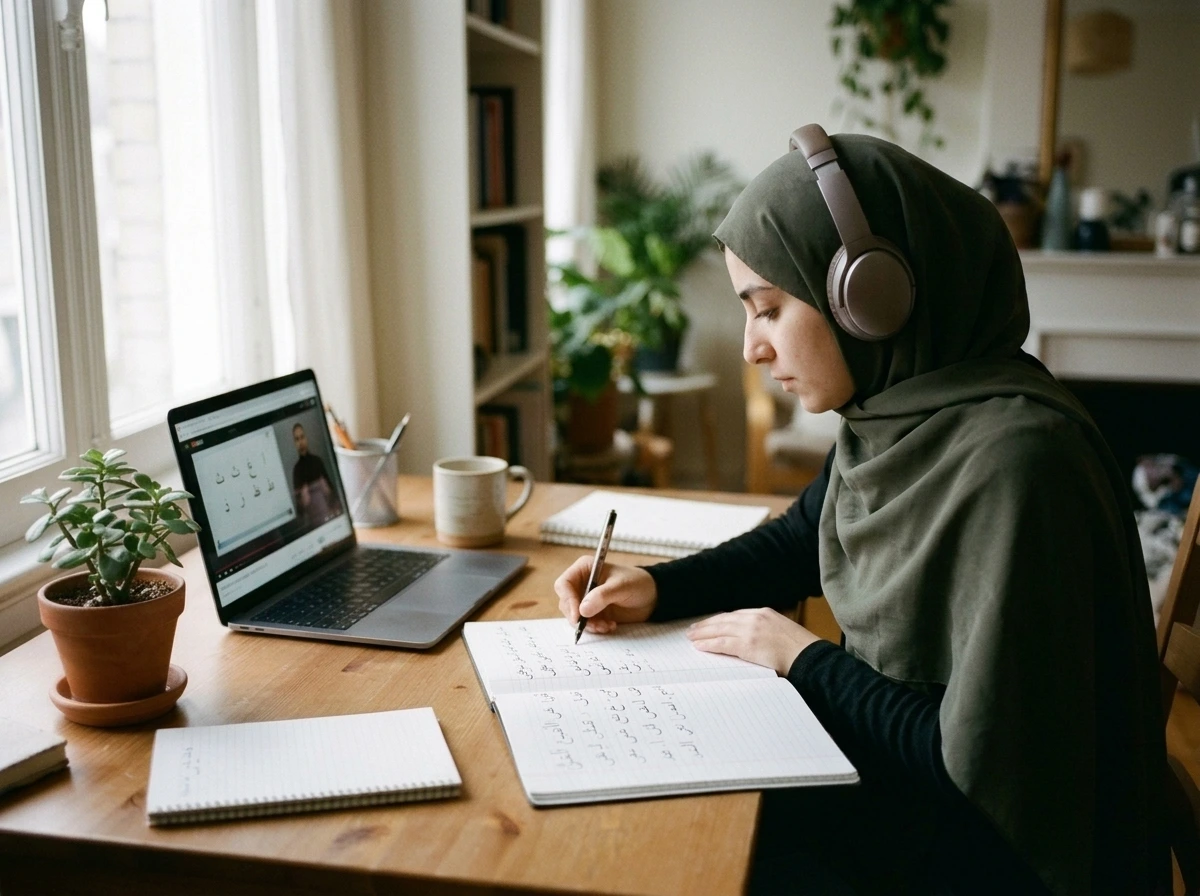
The Arabic alphabet has 28 letters and is written from right to left. Most letters change shape depending on whether they appear at the beginning, middle, or end of a word.
Give this stage two to four weeks. Do not rush it.
Focus on these points:
- Learn each letter’s name, sound, and four forms (isolated, initial, medial, final).
- Practice the sounds that do not exist in English, such as ع (ayn), ح (haa), خ (khaa), and ق (qaaf).
- Learn the short vowel marks, then understand that most everyday text leaves them out.
- Write every letter by hand. Handwriting builds memory faster than tapping a screen.
A common beginner trap is relying on transliteration (Arabic written in Latin letters). It feels easier at first but slows your reading later. Move to real script as early as you can.
Step 3: Build Core Vocabulary
Vocabulary is the engine of any language. Start with the most common words rather than random themes.
- Aim for the first 300 to 500 high-frequency words.
- Learn words inside short phrases, not alone.
- Use spaced repetition flashcards so reviews appear just before you forget.
- Group words by root, which brings us to the next step.
Step 4: Learn Grammar in Small Doses
Arabic grammar looks heavy, yet it is very logical. The trick is to learn it in small pieces tied to real examples.
Key ideas to understand early:
- The root system: Most Arabic words grow from a root of usually three consonants. The root k-t-b relates to writing, so you get words like kitaab (book), kaatib (writer), and maktab (office or desk).
- Gender: Every noun is masculine or feminine, and adjectives must match.
- Sentence types: Arabic uses both verbal sentences (verb first) and nominal sentences (noun first).
- Verb patterns: Verbs follow set patterns that change meaning in predictable ways.
- Definiteness: The article “al” attaches to the front of a noun and changes how adjectives agree.
Learn one concept, then use it in five sentences before moving on.
Step 5: Train Your Ear With Daily Listening
Listening is where online learning shines. Native audio is everywhere, and you can use it from your first week.
Try this simple method:
- Start with slow, learner-friendly audio and short dialogues.
- Replay each clip three times: first for the general idea, then for details, then to repeat aloud.
- Move to children’s shows, short videos, and podcasts as your level grows.
- Match your listening to your target layer. Choose news for MSA or everyday vlogs for a dialect.
Do not worry about catching every word. Comprehension grows in layers.
Step 6: Start Speaking and Writing Early
Many learners wait too long to produce language. Speaking feels uncomfortable, so they postpone it for months.
Start small and start now:
- Shadowing: Play a short sentence, pause, and repeat it, copying rhythm and tone.
- Self-talk: Describe your day in simple Arabic out loud.
- Voice recordings: Record yourself and compare it to native audio.
- Short daily writing: Write three sentences a day about anything. Language exchange communities can offer feedback if you want a reader.
Mistakes are not a sign of failure. They are the raw material of progress.
The Types of Online Resources Worth Using
You do not need a long list of tools. You need a small set that covers different skills. Think in categories rather than brand names.
- Alphabet and pronunciation guides: Interactive charts with audio for each letter.
- Spaced repetition flashcard apps: Best for vocabulary retention.
- Structured video lessons: Good for grammar explained step by step.
- Graded readers and short stories: Simple texts that grow with your level.
- Podcasts and slow-speech audio: Ideal for building listening stamina.
- Native media: Series, news clips, and short videos for real-world exposure.
- Language exchange communities: Practice speaking with people who want to learn your language in return.
- Online dictionaries with root lookup: Essential once you start reading real text.
A balanced week uses at least one tool from each of four areas: vocabulary, grammar, listening, and output (speaking or writing).
A Realistic Weekly Plan (30 to 45 Minutes a Day)
Here is a sample schedule you can adapt. It keeps each session short so it stays sustainable.
- Monday: 10 minutes of flashcards, 15 minutes of a grammar lesson, 10 minutes of writing practice.
- Tuesday: 10 minutes of flashcards, 20 minutes of listening, 10 minutes of shadowing.
- Wednesday: 10 minutes of flashcards, 15 minutes of reading a short text, 10 minutes of speaking aloud.
- Thursday: 10 minutes of flashcards, 15 minutes of grammar review, 15 minutes of writing.
- Friday: 10 minutes of flashcards, 20 minutes of native media with a notepad for new words.
- Saturday: 30 minutes of conversation practice or recorded speaking.
- Sunday: Light review and a quick self-check of what you learned this week.
Consistency matters more than intensity. A short daily habit protects you from the burnout that ends most language journeys.
Common Mistakes When You Learn Arabic Online
Avoid these pitfalls and you will already be ahead of most beginners.
- Mixing dialects too soon: Studying Egyptian, Gulf, and Levantine at once creates confusion. Pick one.
- Staying with transliteration: It becomes a crutch. Switch to the script early.
- Memorizing lists without context: Words learned in isolation fade quickly.
- Skipping listening: Reading skills alone will not help you understand real speech.
- Waiting to speak: Confidence grows only through use.
- Chasing perfection: Arabic has sounds and structures that take time. Aim for progress, not flawless output.
- Constantly switching resources: Finish what you start before moving on.
How to Stay Motivated for the Long Run
Arabic is a marathon, so build habits that protect your energy.
- Track visible wins: Keep a log of words learned, texts read, and minutes spoken.
- Celebrate small milestones: Reading your first full sentence is a real achievement.
- Tie learning to interests: Cooking, football, music, travel, or history can all become Arabic practice.
- Review old material: Seeing how much you now understand is a powerful boost.
- Forgive missed days: Return the next day without guilt.
Many learners notice a turning point around the third or fourth month. The alphabet becomes automatic, patterns start to repeat, and listening suddenly clicks. Pushing through that early period is where the biggest payoff lives.
Key Takeaways
- Decide your goal first, then choose MSA or a specific dialect.
- Spend the first weeks mastering the 28-letter alphabet and its sounds.
- Learn words in context and review them with spaced repetition.
- Use the root system to understand and remember vocabulary faster.
- Listen daily, and start speaking and writing before you feel ready.
- Keep sessions short and consistent rather than long and rare.
Conclusion
Learning a new language is always a journey, and Arabic rewards patience more than talent. When you learn Arabic online with a clear goal, a step-by-step plan, and a daily habit, the language becomes far less intimidating.
Start with the alphabet, build your vocabulary, train your ear, and begin speaking early. Stay focused on one path at a time, and you will be surprised by how quickly the pieces begin to connect.
Sources and Official References
- Foreign Service Institute (U.S. Department of State), Foreign Language Training, Language Difficulty Rankings and Training Time Estimates: https://www.state.gov/foreign-language-training/
- United Nations, Official Languages of the United Nations (Dag Hammarskjöld Library): https://ask.un.org/faq/14463
- Council of Europe, Common European Framework of Reference for Languages (CEFR): https://www.coe.int/en/web/common-european-framework-reference-languages
- Ethnologue, Languages of the World, Arabic (macrolanguage) entry: https://www.ethnologue.com/language/ara
Frequently Asked Questions
1. Can I really learn Arabic online without a classroom?
Yes. With structured lessons, flashcards, audio, and regular speaking practice, you can build solid skills at home. The key is following a clear plan and practicing all four skills: reading, writing, listening, and speaking.
2. How long does it take to learn Arabic online?
It depends on your goal and study time. Many learners reach basic conversation in about six to nine months of steady practice, while professional-level proficiency can take around 2,200 hours according to Foreign Service Institute estimates.
3. Should I learn Modern Standard Arabic or a dialect first?
Choose based on your goal. MSA suits reading, news, and formal writing, while a dialect is better for daily conversation in a specific country. Many learners start with MSA and add one dialect later.
4. Is the Arabic alphabet hard to learn?
It feels unfamiliar at first, but it is very manageable. There are 28 letters, and most learners can read and write them within two to four weeks of regular practice.
5. What is the best daily routine to learn Arabic online?
A short, balanced routine works best. Aim for 30 to 45 minutes combining vocabulary review, a small grammar lesson, listening, and a few minutes of speaking or writing.
Disclaimer: This article is provided for educational and informational purposes only and reflects general Islamic scholarly perspectives on Surah Yaseen. It is not a substitute for guidance from a qualified Islamic scholar or certified religious authority. For matters of hadith authenticity, personal practice, or specific religious rulings, please consult a certified professional in Islamic studies.
