Bedtime Quran Stories: 9 Gentle Tales and a Simple Routine to Calm Your Child’s Night
Bedtime Quran Stories
What If the Last Thing Your Child Hears Tonight Is the Best of Stories?
The Quran describes the story of Prophet Yusuf as part of the “best of stories” (Surah Yusuf, 12:3). Imagine your child drifting off to sleep with that kind of story in their heart instead of a screen glowing in their eyes.
Introduction
Bedtime Quran stories are short, calm retellings of the true narratives in the Quran, shared with children in the quiet minutes before sleep. They give families a routine that is peaceful, meaningful, and rooted in revelation.
Many parents want a bedtime habit that does more than fill time. They want their children to know the Prophets, learn right from wrong, and feel safe. This guide shows you how to do that with accuracy and warmth.
You will learn which stories suit which ages, how to tell them without adding things the Quran never said, and how to pair them with the bedtime recitations taught by the Prophet ﷺ.
Why Bedtime Quran Stories Work So Well
Bedtime is one of the few moments in the day when children are close, quiet, and listening. A story told in that window tends to stay with them.
A Calming Signal for the Brain and Body
Children thrive on predictable routines. When the same gentle story time happens every night, the body learns that it is time to slow down.
Parents often notice that a soft voice and a familiar rhythm settle restless children faster than negotiation or screens do.
Faith Learned Through Narrative
Children understand people and events far more easily than abstract rules. A story about a mother who trusted Allah while placing her baby in a river teaches reliance on Allah better than a lecture could.
The Quran itself says that the stories of the earlier Prophets hold lessons for people of understanding (Surah Yusuf, 12:111). Stories are not decoration in the Quran. They are a method of teaching.
Time Together Builds Attachment to the Quran
When a child associates the Quran with a parent’s lap, a soft light, and undivided attention, love for the Quran grows naturally. That emotional memory often matters more than how many details the child can recall.
Key benefits at a glance:
- A calm and predictable sleep routine
- Moral and spiritual lessons in a form children can absorb
- Familiarity with the Prophets and their examples
- Daily one-on-one time between parent and child
- A positive emotional link to the Quran
Keep It Authentic: Quran Text vs Storybook Embellishment
This is where many families, and even some published children’s books, go wrong. Authority and trust matter here, because children remember what they hear first.
Start from the Quran itself. Read the relevant verses and a trusted translation before you tell the story. Then retell it in simple words.
Separate what is established from what is added. Many popular versions include names, dialogues, and details that come from later retellings and not from the Quran or authentic hadith. If a detail is not in a reliable source, leave it out or say plainly, “Allah has not told us that part.”
Avoid inventing conversations or emotions for the Prophets. Describing their character with respect is fine. Putting made-up speech in their mouths is not.
Choose books carefully. Look for children’s titles that cite the Quran, avoid fabricated details, and show the Prophets with dignity. Illustrations should respect the Islamic guidance on depicting Prophets, so many families prefer books with nature scenes and symbols instead of faces.
Choosing Bedtime Quran Stories by Age
Not every story fits every child. A story that thrills a ten-year-old can unsettle a four-year-old.
Ages 2 to 4: Very short stories, lots of repetition, and gentle imagery. Think animals, boats, stars, and the moon.
Ages 5 to 7: Simple plots with a clear lesson. Children at this age love asking, “And then what happened?”
Ages 8 to 11: Fuller storylines, cause and effect, and questions about why people made certain choices.
Teens: Reflection-based discussion rather than storytelling. Ask what the story means for real life today.
9 Gentle Bedtime Quran Stories to Start With
These stories are chosen because they are peaceful in tone, rich in meaning, and easy to adapt for children.
1. Prophet Nuh and the Ark (Surah Hud, 11:25-48)
Nuh called his people to Allah patiently for a very long time. When Allah commanded him to build the ark, he obeyed, and the believers were saved.
Lesson: Patience and obedience to Allah, even when others laugh at you.
Bedtime tip: Focus on the safety of the ark and the mercy of Allah, and keep the flood description brief for younger children.
2. Prophet Ibrahim and the Stars, Moon, and Sun (Surah Al-An’am, 6:75-79)
Ibrahim looked at a star, then the moon, then the sun, and realised each one set and disappeared. He concluded that only the One who never disappears deserves worship.
Lesson: Thinking about creation leads us to the Creator.
Bedtime tip: This is perfect to tell near a window with the night sky outside.
3. Prophet Yusuf and His Dream (Surah Yusuf)
Yusuf saw a dream of eleven stars, the sun, and the moon bowing to him. His father Yaqub, a Prophet himself, gently told him to keep it private.
Lesson: Beautiful patience (sabr jameel) and trust in Allah’s plan.
Bedtime tip: Tell this one across several nights. For younger children, stop at the point where Yusuf is reunited with his family, and skip the harder middle sections.
4. Prophet Musa’s Mother and the Basket (Surah Al-Qasas, 28:7-13)
Allah inspired Musa’s mother to place her baby in the river and not to fear or grieve. Allah promised to return him to her, and He did.
Lesson: Trusting Allah when you cannot see the outcome.
Bedtime tip: Emphasise the promise of Allah and the happy reunion. Younger children do not need the background about the ruler’s oppression.
5. Prophet Yunus and the Whale (Surah Al-Anbiya, 21:87-88)
Yunus left his people in frustration, ended up in the belly of the fish, and called out in the darkness a supplication of repentance. Allah answered him and rescued him.
Lesson: Allah hears us even in the darkest place, and sincere repentance is always welcome.
Bedtime tip: Teach your child the words of Yunus’s dua. It is a beautiful phrase to carry into sleep.
6. The Ant and Prophet Sulaiman (Surah An-Naml, 27:18-19)
An ant warned the other ants to enter their homes so they would not be crushed. Sulaiman heard her, smiled, and thanked Allah for His blessings.
Lesson: Gratitude, kindness, and awareness of even the smallest creatures.
Bedtime tip: Children usually adore this one. Ask them what the ant might have felt.
7. The People of the Cave (Surah Al-Kahf, 18:9-26)
A group of young believers fled their people to protect their faith and took refuge in a cave. Allah caused them to sleep for a very long time, and they awoke to a changed world.
Lesson: Allah protects those who hold on to their faith.
Bedtime tip: A story about sleep is a natural fit for bedtime. Keep the focus on Allah’s care, not on debates about exact numbers.
8. Prophet Ibrahim and the Fire (Surah Al-Anbiya, 21:68-70)
When Ibrahim’s people threw him into a fire, Allah commanded the fire to be cool and safe for him.
Lesson: Nothing can harm you without Allah’s permission.
Bedtime tip: For younger children, present it as “Allah protected Ibrahim,” without lingering on the danger.
9. The Story of the Elephant (Surah Al-Fil, 105)
An army with elephants came to destroy the Kaaba, and Allah sent flocks of birds to stop them. This short surah is easy to memorise and retell.
Lesson: Allah protects His house and His sacred things.
Bedtime tip: Recite the surah first, then explain it in two or three sentences.
Stories to Save for Older Children
Some narratives in the Quran involve loss, violence, or heavy themes. They are authentic and valuable, but they need maturity and context.
Better for later years:
- The conflict between the two sons of Adam
- The destruction of earlier nations
- The details of Pharaoh’s oppression
- The trials in the later chapters of Yusuf’s story
Introducing these in daytime conversation, with room for questions, is often kinder than doing so at lights-out. A child who goes to sleep unsettled has not benefited from the story.
Also Read: Benefits of Reading Surah Yaseen Every Day: What Actually Changes
How to Tell Bedtime Quran Stories Step by Step
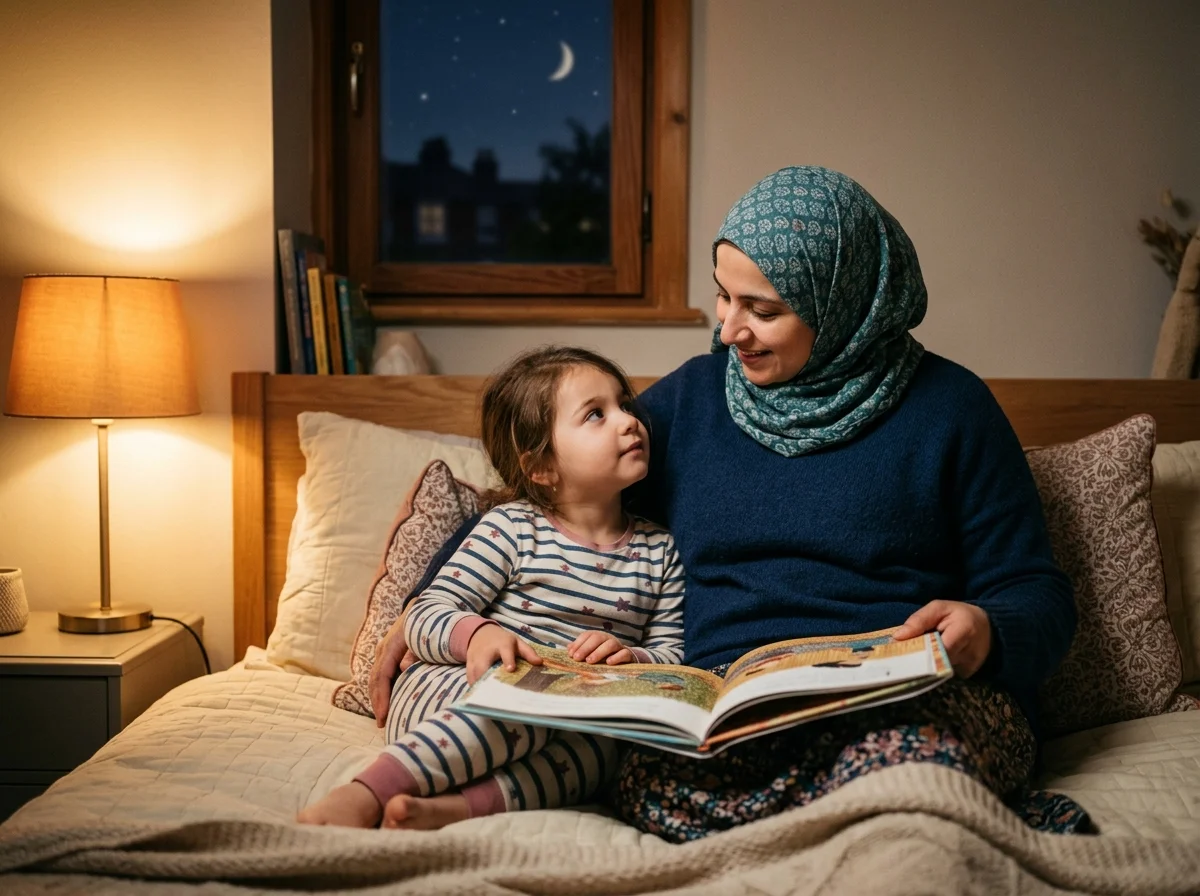
A good routine is simple enough to repeat every night. Here is one that works for most families.
- Prepare your space. Dim the lights, put devices away, and sit close together.
- Begin with Bismillah. This marks the moment as blessed and signals a transition.
- Tell the story in your own words. Keep it to five or ten minutes, with a calm voice.
- Read or recite a short verse. Let your child hear the actual words of the Quran, even if only one ayah.
- Ask one gentle question. For example, “What do you think Yunus felt in the dark?”
- Close with a lesson in one sentence. Keep it light, not preachy.
- End with dua. Make a short supplication together before sleep.
Practical tips that help:
- Use the same time each night so it becomes a habit
- Let children choose between two stories to give them ownership
- Keep a small notebook of which stories you have told
- Lower your voice as the story nears its end
- Do not turn it into a test or an interrogation
Pairing Stories with the Bedtime Sunnah
The Prophet ﷺ gave clear guidance on what to recite before sleep, and these fit beautifully around a story.
Ayat al-Kursi (Surah Al-Baqarah, 2:255). It is reported in Sahih al-Bukhari that reciting it at bedtime brings protection from Allah through the night.
The last two verses of Surah Al-Baqarah. The Prophet ﷺ said these verses are sufficient for whoever recites them at night, as reported in the two Sahih collections.
The three Quls. Aisha (may Allah be pleased with her) reported that the Prophet ﷺ would gather his palms, recite Surah Al-Ikhlas, Al-Falaq, and An-Nas, blow into them, and wipe over his body, as reported in Sahih al-Bukhari.
Surah Al-Mulk and Surah As-Sajdah. It is reported in Jami at-Tirmidhi that the Prophet ﷺ would not sleep until he recited these.
A simple pattern is story first, then the recitations, then dua. The story opens the heart, and the recitations close the day with protection and remembrance.
Common Mistakes Parents Make
Telling frightening versions. Children do not need vivid descriptions of punishment to understand a lesson.
Adding unverified details. This is the most common error and the easiest to avoid with a quick check of a reliable tafsir.
Rushing. If you are watching the clock, your child will feel it. Shorter and calmer is better than longer and hurried.
Forcing the lesson. Let the story do its work, and trust that the meaning will return to your child’s mind later.
Skipping the Quran text entirely. Retelling is helpful, but children should also hear actual verses so the story is anchored to revelation.
Key Takeaways
- Bedtime Quran stories work best when short, calm, and consistent
- Always begin from the Quran and reliable tafsir, not from embellished retellings
- Match the story to your child’s age and emotional readiness
- Pair the story with the authentic bedtime recitations of the Sunnah
- Keep the focus on Allah’s mercy, protection, and guidance
Conclusion
Bedtime Quran stories turn the final minutes of the day into a gift of calm, character, and connection. They teach children who the Prophets were, why patience and gratitude matter, and that Allah is always near.
Start small, stay faithful to the Quran, and let consistency do the rest. One gentle story tonight can become a memory your child carries for the rest of their life.
Sources and Official References
- The Holy Quran, Surah Al-Baqarah (2): https://quran.com/2
- The Holy Quran, Surah Al-An’am (6): https://quran.com/6
- The Holy Quran, Surah Hud (11): https://quran.com/11
- The Holy Quran, Surah Yusuf (12): https://quran.com/12
- The Holy Quran, Surah Al-Kahf (18): https://quran.com/18
FAQs
1. What are the best bedtime Quran stories for toddlers?
The best choices are very short and peaceful. The ant and Prophet Sulaiman, Prophet Nuh and the ark, and the story of the elephant work well. Use simple words, repeat key phrases, and keep each telling to a few minutes.
2. At what age can I start telling bedtime Quran stories?
You can begin as early as two, as long as the story is short and gentle. Even infants benefit from hearing a calm voice and the sound of Quran recitation. Adjust the detail and length as your child grows.
3. Are all stories in children’s Islamic storybooks accurate?
Not always. Some books add names, dialogues, or events that are not in the Quran or authentic hadith. Check the references the author uses, and compare the story with the Quranic verses and a trusted tafsir before sharing it.
4. Should I recite Quran verses during the story or just retell it?
Do both. Retelling in your own words helps understanding, while reciting one or two relevant verses connects the story to the actual words of Allah. This builds familiarity with the Quran without overwhelming a young child.
5. How long should bedtime Quran stories be?
Five to ten minutes is enough for most children. Toddlers may need only two or three minutes. A short, consistent story is more effective than a long one that makes the child restless.
Disclaimer: This article is provided for educational and informational purposes only and reflects general Islamic scholarly perspectives on Surah Yaseen. It is not a substitute for guidance from a qualified Islamic scholar or certified religious authority. For matters of hadith authenticity, personal practice, or specific religious rulings, please consult a certified professional in Islamic studies.
