Hajj Meaning and the Powerful Journey of Faith
Hajj Meaning: The True Spiritual Significance of the Fifth Pillar of Islam
Every year, millions of Muslims from every corner of the world make their way to the holy city of Mecca, Saudi Arabia, united by a singular divine command. This extraordinary convergence of faith, devotion, and sacrifice is known as Hajj. But beyond the images of white-clad pilgrims circling the Kaaba, what is the real Hajj meaning? What does this pilgrimage represent at its deepest spiritual, historical, and theological core?
Understanding the Hajj meaning requires looking beyond the surface of rituals and entering the profound world of Islamic theology, prophetic tradition, and the universal human longing for closeness to God.
What Is the Hajj Meaning in Islam?
The word “Hajj” comes from the Arabic root “Hajja,” which means to intend a journey or to set out with purpose toward a revered destination. In Islamic terminology, Hajj refers to the annual pilgrimage to Mecca, specifically to the Masjid al-Haram and its surrounding sacred sites, performed during the Islamic month of Dhul Hijjah.
The Hajj meaning in Islam is inseparable from its status as the Fifth Pillar of Islam. It stands alongside the Shahada (declaration of faith), Salah (prayer), Zakat (charity), and Sawm (fasting during Ramadan) as one of the five foundational obligations of the Muslim faith. Allah commands it in the Quran in Surah Al Imran (3:97): “And Hajj to the House is a duty that mankind owes to Allah, for those who are able to undertake the journey.”
This divine obligation carries immense weight. It is required once in a lifetime for every Muslim who is physically capable and financially able to make the journey. This condition of istita’ah (ability) reflects the mercy within the obligation itself.
The Historical Roots of Hajj: Prophet Ibrahim and the Sacred House
To fully grasp the Hajj meaning, one must understand its origins, which stretch back thousands of years to the Prophet Ibrahim (Abraham, peace be upon him) and his family.
According to Islamic tradition, Allah commanded Prophet Ibrahim to leave his wife Hajar (Hagar) and infant son Ismail (Ishmael) in the barren valley of Mecca. In obedience to that divine command, Ibrahim did so. When Hajar desperately searched for water for her dying child, running seven times between the hills of Safa and Marwa, the miracle of Zamzam water sprang forth from the earth. This event is not merely historical background; it is ritually re-enacted by every pilgrim during Sa’i, the walk between Safa and Marwa.
Years later, Allah commanded Prophet Ibrahim and his son Ismail to build the Kaaba, the cube-shaped structure at the heart of Masjid al-Haram. The Kaaba is referred to in the Quran as the Bayt Allah, the House of Allah, and represents the first house of worship established for all of humanity. After completing its construction, Ibrahim was commanded to call all of mankind to Hajj. The Quran records in Surah Al Hajj (22:27): “And proclaim the Hajj among mankind; they will come to you on foot and on every lean camel, from every deep and distant mountain highway.”
This Abrahamic legacy is central to the Hajj meaning. Each ritual in Hajj is a living re-enactment of the trials, sacrifices, and devotion of Ibrahim, Hajar, and Ismail. Performing Hajj is, in essence, walking in the footsteps of the father of monotheism.
The Five Pillars of Islam and the Place of Hajj
The Hajj meaning cannot be separated from the broader framework of Islamic worship. Within the Five Pillars of Islam, Hajj holds a unique position as the most physically, financially, and emotionally demanding act of worship.
While Salah is performed five times daily and Sawm is observed for a month each year, Hajj is a once-in-a-lifetime obligation, making its performance especially significant. The pilgrimage brings together all forms of Islamic worship: physical movement and effort, financial sacrifice, spiritual remembrance of Allah (dhikr), communal brotherhood and sisterhood, and total submission to divine command.
Islamic scholars describe Hajj as a complete embodiment of the concept of Tawhid, the Oneness of Allah. Every ritual, from the Tawaf (circling of the Kaaba) to standing at the Plain of Arafat, reaffirms that there is no God but Allah and that all of humanity stands equal before Him.
Key Rituals of Hajj and Their Spiritual Meanings
Understanding what each ritual means adds depth to the overall Hajj meaning.
Ihram: The Hajj begins with the pilgrim entering a state of ihram, wearing two seamless white garments. This symbolizes equality before Allah. No status markers remain; kings and commoners look identical. It also represents spiritual purity, as the pilgrim abandons worldly distractions and enters a sacred state.
Tawaf: Pilgrims circle the Kaaba seven times in a counterclockwise direction. The Tawaf represents the believer’s life revolving around the worship of Allah. Just as the planets orbit the sun, the Muslim’s entire existence orbits divine obedience.
Sa’i: Walking seven times between Safa and Marwa commemorates Hajar’s desperate search for water and her absolute trust in Allah. It teaches that human effort combined with divine trust is the foundation of survival and faith.
Wuquf at Arafat: Standing at the Plain of Arafat on the 9th of Dhul Hijjah is considered the spiritual pinnacle of Hajj. The Prophet Muhammad (peace be upon him) said, “Hajj is Arafat.” Millions of pilgrims stand together, weeping, supplicating, and seeking forgiveness. It is described as a foretaste of the Day of Judgment, when all of humanity will stand before Allah. This moment is often described by returning pilgrims as the most powerful spiritual experience of their lives.
Muzdalifah and Mina: After Arafat, pilgrims proceed to Muzdalifah for night prayers and then to Mina, where they symbolically stone three pillars known as the Jamarat. This ritual commemorates Ibrahim’s rejection of Shaytan (Satan) when the devil tried to dissuade him from obeying Allah’s command to sacrifice his son. It symbolizes the pilgrim’s own rejection of evil and temptation.
Eid al-Adha and the Sacrifice: The pilgrimage concludes with Eid al-Adha, the Festival of Sacrifice, commemorating Ibrahim’s willingness to sacrifice his son Ismail in obedience to Allah. This act of ultimate submission is at the very heart of the Hajj meaning: complete surrender to the will of God.
Also Read: Best Eid el Hajj Complete Guide for a Blessed 2026
Hajj as a Symbol of Muslim Unity and Brotherhood
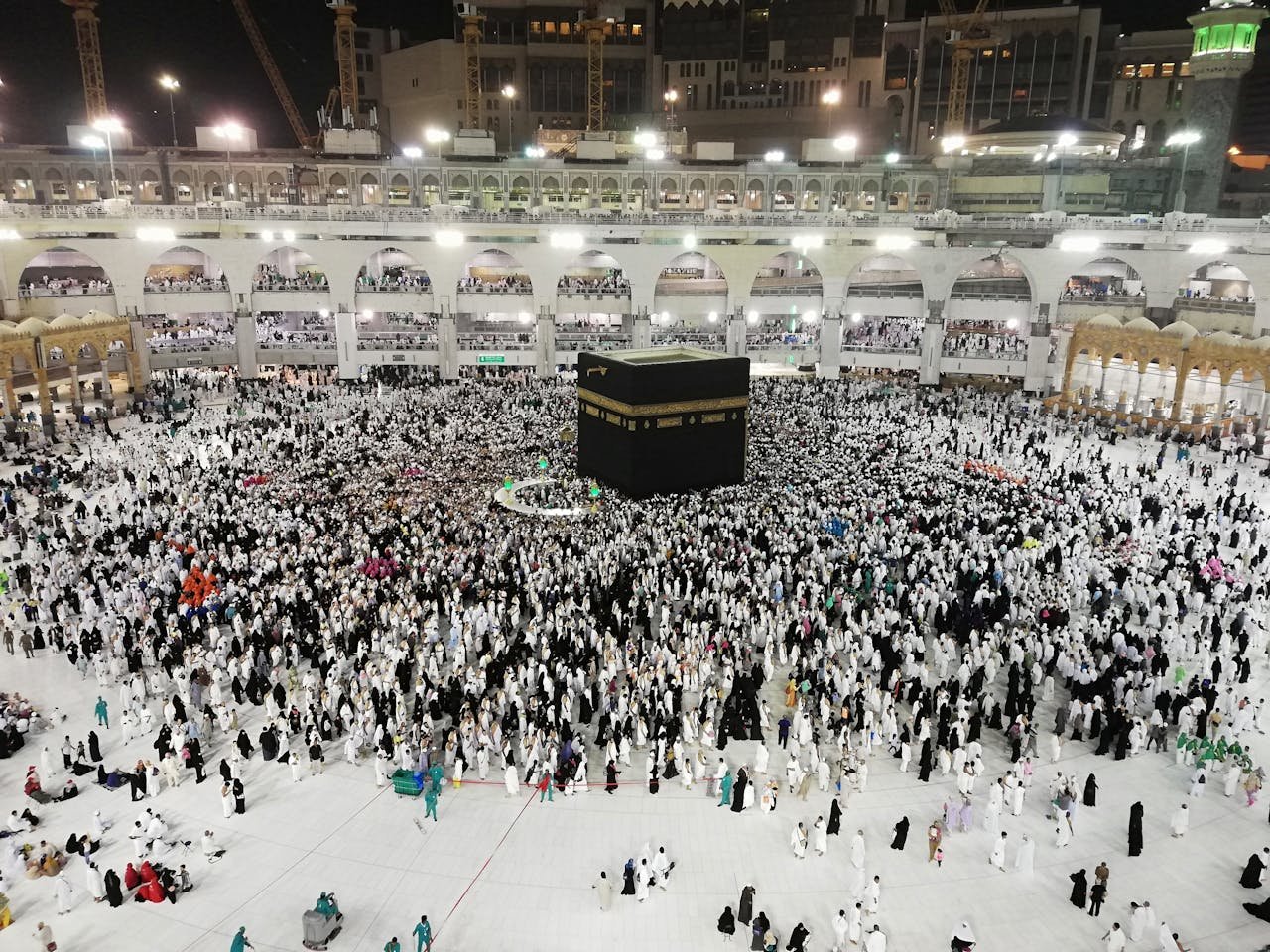
One of the most powerful dimensions of the Hajj meaning is its role as the greatest annual gathering of humanity based on faith. Over two million Muslims from more than 180 countries converge on Mecca each year. They speak different languages, belong to different ethnicities, and come from vastly different economic backgrounds, yet they stand side by side in identical white garments, performing the same rituals, calling upon the same God.
This universal gathering dissolves racial, national, and class barriers. The African pilgrim stands beside the Chinese pilgrim; the wealthy Saudi stands alongside the poor Pakistani farmer. All distinctions fade. Malcolm X, the American civil rights leader, famously wrote about the transformative power of this equality he witnessed during his Hajj in 1964, describing it as a revelation about the universal brotherhood Islam teaches.
The Prophet Muhammad (peace be upon him) reinforced this in his Farewell Sermon, delivered at Arafat during his only Hajj in 632 CE: “There is no superiority of an Arab over a non-Arab, nor of a non-Arab over an Arab, nor of a white man over a black man, nor a black man over a white man, except through God-consciousness (Taqwa).”
Spiritual Transformation: What Hajj Does to the Believer
The Hajj meaning extends beyond the five-day pilgrimage itself. Islamic tradition holds that a Hajj Mabrur, a Hajj performed with sincere devotion, free from sin and ostentation, earns the reward of all past sins being forgiven. The Prophet Muhammad said: “Whoever performs Hajj and does not commit any obscenity or transgression shall return as pure as the day his mother gave birth to him.” (Bukhari and Muslim)
This spiritual cleansing is one reason why returning pilgrims are honored with the title “Al Hajji” or “Al Hajja,” a mark of spiritual distinction and renewed commitment to faith.
Beyond forgiveness, Hajj is a transformative spiritual journey. Pilgrims often describe returning with a profound sense of purpose, gratitude, and detachment from material concerns. The experience of standing at Arafat, of circumambulating the Kaaba, and of drinking from the Zamzam well leaves an imprint that reshapes the believer’s relationship with Allah, with fellow humans, and with their own soul.
Types of Hajj: Ifrad, Tamattu, and Qiran
Islamic jurisprudence identifies three valid ways of performing Hajj, each with slightly different structures.
Hajj al-Ifrad involves performing Hajj alone without combining it with Umrah. Hajj al-Tamattu involves performing Umrah first during the months of Hajj and then entering ihram again for Hajj. This is the method most commonly practiced today, particularly by pilgrims traveling from outside Saudi Arabia. Hajj al-Qiran involves entering ihram for both Umrah and Hajj together without exiting ihram between the two.
Each of these types fulfills the Hajj obligation, though scholars differ on which is most preferred. The Prophet Muhammad performed Hajj al-Qiran during his farewell pilgrimage, though he advised his companions to perform Hajj al-Tamattu for ease.
Hajj Versus Umrah: Key Differences
While both Hajj and Umrah involve visiting the Masjid al-Haram and performing Tawaf and Sa’i, they differ significantly in obligation, timing, and scope.
Hajj is obligatory for every capable Muslim at least once in a lifetime, performed only during the specific days of Dhul Hijjah. Umrah, often called the lesser pilgrimage, is a Sunnah act that can be performed at any time of the year. Hajj includes the unique rituals of Arafat, Muzdalifah, Mina, and the stoning of the Jamarat, which are not part of Umrah.
The Hajj meaning therefore encompasses a fuller spectrum of Islamic devotion, historical memory, and spiritual striving than Umrah, though both hold great merit.
The Contemporary Hajj: Organization and Global Significance
Today, the Hajj is managed by the Saudi Arabian government through the Ministry of Hajj and Umrah. The sheer scale of the modern pilgrimage involves extraordinary logistical planning, with systems for transportation, crowd management, healthcare, and accommodation serving millions of pilgrims over several days.
Modern expansions of Masjid al-Haram and improvements in infrastructure have made the pilgrimage more accessible, though scholars and pilgrims alike note the importance of preserving the spiritual essence of the journey amid modernization.
The global Muslim community, the Ummah, views Hajj as a living symbol of unity and shared purpose. In a world often divided by politics and conflict, the annual Hajj remains a remarkable demonstration of peaceful communal devotion.
Conclusion: The Eternal Hajj Meaning
The Hajj meaning transcends a mere set of rituals or a religious tourism event. It is one of the most profound acts of worship in human history, connecting Muslims to their Prophet Ibrahim, to the teachings of the Prophet Muhammad, and ultimately to Allah. It embodies submission, sacrifice, equality, remembrance, repentance, and renewal.
Whether you are a Muslim preparing for your first pilgrimage or simply seeking to understand one of the world’s great religious traditions, the Hajj stands as a testament to the enduring human search for the divine. Its meaning is not confined to the hills of Mecca; it resonates in the hearts of over 1.8 billion Muslims worldwide, calling them toward a life of purpose, gratitude, and God-consciousness.
FAQs
Q1: What is the literal meaning of Hajj?
The Arabic word Hajj literally means “to intend a journey” or “to set out toward a revered place.” In Islamic context, it specifically refers to the annual pilgrimage to Mecca performed during Dhul Hijjah.
Q2: Why is Hajj important in Islam?
Hajj is the Fifth Pillar of Islam and is obligatory for every Muslim who is physically and financially able to perform it at least once in their lifetime. It represents the ultimate act of submission to Allah and carries enormous spiritual rewards, including the forgiveness of all past sins.
Q3: What happens during Hajj?
Hajj involves several key rituals including entering the state of Ihram, performing Tawaf around the Kaaba, walking between Safa and Marwa (Sa’i), standing at the Plain of Arafat, spending the night at Muzdalifah, stoning the Jamarat at Mina, and offering an animal sacrifice on Eid al-Adha.
Q4: What is the spiritual meaning of standing at Arafat?
Standing at Arafat is considered the climax of Hajj. It is a powerful spiritual moment representing humility, repentance, and supplication before Allah. It serves as a reminder of the Day of Judgment when all of humanity will stand before God.
Q5: What is the difference between Hajj and Umrah?
Hajj is an obligatory pilgrimage performed during specific days in Dhul Hijjah and includes rituals at Arafat, Muzdalifah, and Mina. Umrah is an optional lesser pilgrimage that can be performed at any time of year and does not include these additional rituals.
Q6: Who must perform Hajj?
Hajj is obligatory for every adult Muslim who is physically healthy, mentally sound, and financially able to afford the journey without harming their family’s financial wellbeing. This condition is known as Istita’ah (ability).
Q7: What does wearing Ihram symbolize during Hajj?
The white seamless garments of Ihram symbolize equality and spiritual purity. All pilgrims look the same regardless of wealth or social status, reflecting the Islamic teaching that all humans are equal before Allah.
If you wish to learn the Quran online or enroll in one of our Quran courses, click below and start your learning journey today.
Explore Our Courses →
