Online Hifz Course: How to Memorize the Quran From Home With a Structure That Actually Works
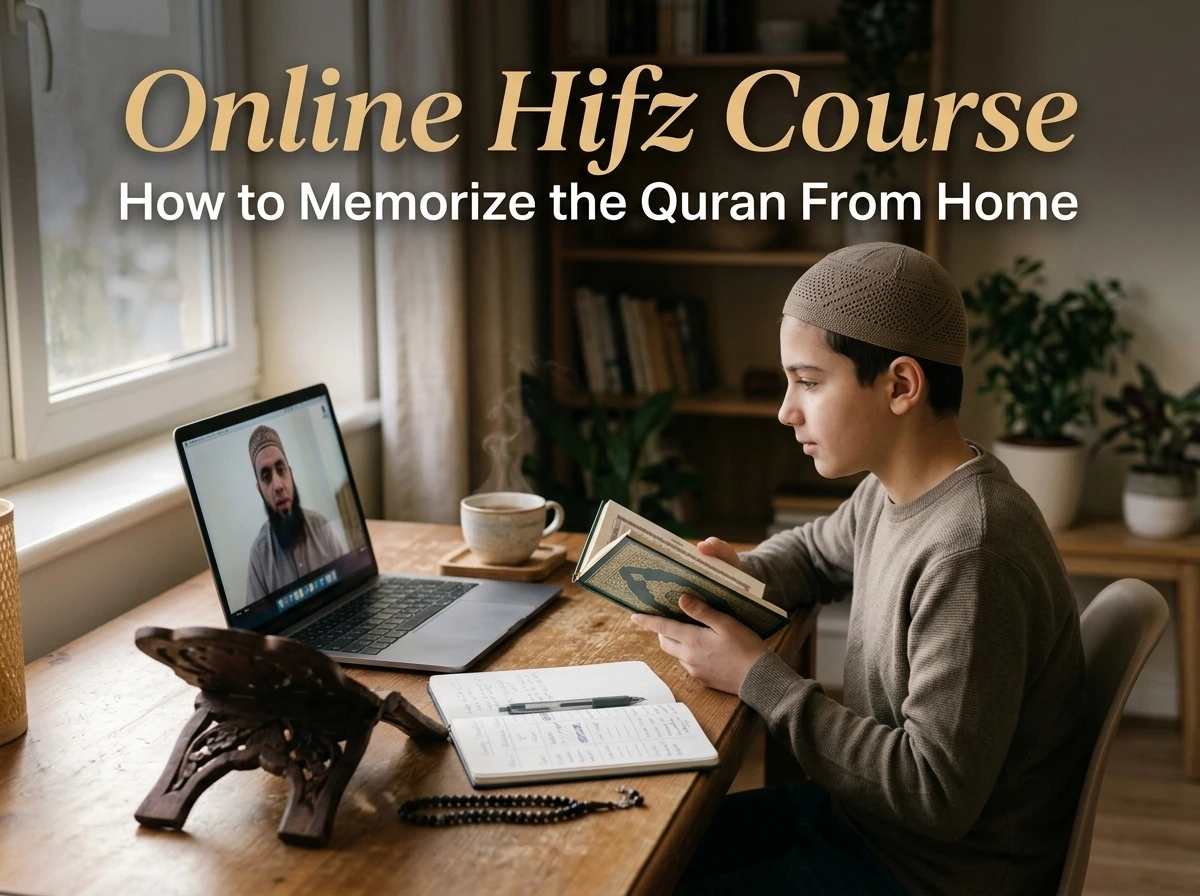
Online Hifz Course
What If the Biggest Barrier to Memorizing the Quran Is Not Your Memory, but Your Location?
For generations, many Muslims dreamed of memorizing the Quran but could not relocate to a madrasa, leave their job, or move their family. Distance, schedules, and a lack of qualified teachers nearby quietly ended many of those dreams.
That barrier is now much smaller. A well-designed online Hifz course brings a qualified teacher, a clear plan, and daily accountability into your home.
Introduction
An online Hifz course is a structured program in which a learner memorizes the Quran under the guidance of a qualified teacher through live video sessions. It follows the same core principles as traditional memorization: new lessons, short-term review, and long-term revision.
The format is new, but the method is not. What changes is the delivery, and that is where many learners succeed or fail.
This guide explains how an online Hifz course works, who benefits most, how to choose a good one, and how to avoid the mistakes that cause people to quit. It is based on common patterns in Quran memorization and the principles scholars have long taught.
Why Memorizing the Quran Remains a Priority
The Quran itself encourages its memorization and study: “And We have certainly made the Quran easy for remembrance, so is there any who will remember?” (Quran 54:17).
The Prophet Muhammad (peace be upon him) said: “The best among you are those who learn the Quran and teach it.” (Sahih al-Bukhari). This hadith motivates many families to start a memorization journey in the first place.
What Is an Online Hifz Course?
An online Hifz course is not simply watching recitation videos or using a memorization app. It is a guided, teacher-led program with a fixed schedule, assessment, and progress tracking.
A complete course usually includes:
- Live one-to-one or small group sessions over video call
- A daily plan for new memorization and revision
- Correction of pronunciation and Tajweed during recitation
- Regular testing of previously memorized portions
- Progress reports shared with the learner or parents
The key word is guided. Memorization without a teacher who can hear and correct you often locks in mistakes that are hard to fix later.
Why More Families Choose an Online Hifz Course
Flexibility Without Losing Structure
Sessions can be scheduled around school, work, or time zones. A student in Toronto can learn with a teacher in Cairo or Karachi at a time that suits both.
Flexibility does not mean casual effort. The best programs keep strict daily routines even when the timing is flexible.
Access to Qualified Teachers
In many towns, there is no teacher who holds an ijazah (a chain of authorization in Quran recitation). Online learning removes that limit.
This matters most for reverts, families in non-Muslim majority countries, and adults who cannot attend a traditional institute.
Personal Attention
Traditional classrooms may have many students per teacher. In a one-to-one online session, every minute of the lesson is focused on one learner.
That means faster correction, better pacing, and fewer gaps in understanding.
A Safe and Comfortable Learning Space
Younger children often feel more relaxed at home. Parents can also observe lessons, support revision, and build a Quran-centered routine in the household.
Lower Travel and Relocation Costs
Memorization through a traditional institute may require relocation or daily commuting. Online learning removes those costs and saves hours each week.
Who Is an Online Hifz Course Suitable For?
Children and Teenagers
Children often memorize quickly, but they need routine and supervision. Parents play a major role in keeping sessions consistent and revision regular.
Short, focused sessions work better than long, tiring ones for younger learners.
Adults and Working Professionals
Many adults begin Hifz later in life. They may memorize more slowly at first, but they bring discipline, understanding, and motivation.
A realistic schedule is essential. Even 30 to 60 focused minutes daily can produce steady progress when practiced consistently.
New Muslims and Reverts
Reverts often need to build reading fluency first. A good course will not rush them into memorization before they can read the Arabic script accurately.
Those Who Want to Complete or Revise Previous Memorization
Some learners memorized parts of the Quran years ago and want to restore them. An online Hifz course can include a structured revision plan to rebuild strength and confidence.
What You Need Before Starting
Starting without preparation is one of the most common reasons for frustration. Before joining an online Hifz course, check these foundations:
- Ability to read the Quran fluently, even if slowly
- Basic Tajweed knowledge, such as the articulation points of letters and common rules
- A stable internet connection and a working microphone
- A quiet space with minimal distraction
- A fixed daily time that you can protect
If reading is still weak, a short preparatory phase is wise. Memorizing incorrect pronunciation only creates more work later.
How a Well-Structured Online Hifz Course Works
Most reputable programs follow a three-part system that has been used for centuries.
1. Sabaq (The New Lesson)
This is the new portion memorized each day. It may be a few lines or half a page, depending on the learner’s age, ability, and time.
The teacher listens to the learner recite it, corrects errors, and confirms accuracy before moving on.
2. Sabqi (Recent Revision)
Sabqi is the review of the last several days or weeks of new memorization. This keeps recent material fresh while it is still fragile.
Skipping Sabqi is a common mistake. New verses fade quickly without it.
3. Manzil (Long-Term Revision)
Manzil is the revision of older portions memorized earlier. Learners usually divide older material into sections and revise a set amount each day, cycling through it regularly.
This is what turns memorization into permanent retention.
A Sample Daily Routine
Here is a simple example of what a daily plan might look like:
- Morning (20 to 30 minutes): Prepare the new lesson by reading it repeatedly
- Live session (30 to 45 minutes): Recite new lesson, Sabqi, and receive correction
- Evening (20 to 30 minutes): Revise Manzil independently
- Before sleep (5 to 10 minutes): Light review of the new lesson
Exact timing varies, but the pattern should be consistent every day.
Technology and Setup for Online Hifz
Good technology supports good memorization. It does not need to be expensive, but it should be reliable.
- Use a laptop, tablet, or phone with a clear screen and stable stand
- Use a headset or external microphone if possible, so the teacher can hear subtle pronunciation differences
- Test your internet before each session
- Keep a printed or digital Mushaf of the same script style used throughout your memorization
That last point matters more than most learners realize. Using one consistent Mushaf helps the brain build a visual map of each page, which strongly supports recall.
How to Choose the Right Online Hifz Course
Not every online program is equal. Use this checklist to evaluate any course before committing.
Qualifications of the Teacher
- Does the teacher hold an ijazah or recognized qualification in Quran recitation?
- Do they have experience teaching Hifz specifically, not just basic reading?
- Do they speak a language you or your child understands well?
Course Structure
- Is there a clear plan covering Sabaq, Sabqi, and Manzil?
- Are sessions regular and well-paced?
- Is there a written or recorded record of progress?
Assessment and Feedback
- Are there monthly or periodic tests?
- Do parents or learners receive regular updates?
- Is feedback specific, or just general praise?
Trial Session
A reputable provider will usually offer a trial lesson. Use it to evaluate the teacher’s patience, clarity, and ability to correct without discouraging.
Red Flags to Avoid
- Promises of memorizing the entire Quran in an unrealistically short time
- No testing or revision plan
- Teachers who rush through new lessons without correcting mistakes
- Large group sessions where no individual recitation is heard
- Frequent last-minute cancellations or substitute teachers
A teacher who tells you that the process requires patience is usually more trustworthy than one who promises shortcuts.
How Long Does an Online Hifz Course Take?
There is no single answer. Completion time depends on the learner’s age, memory, daily time commitment, prior reading ability, and revision discipline.
As a general range, many dedicated learners take around two to four years or more to complete the Quran, while others progress more slowly alongside school or work. Neither pace is a failure.
Rather than focus on speed, measure these three things:
- Accuracy of recitation
- Strength of retention over time
- Consistency of daily effort
A slower learner with strong revision often ends up with better retention than a fast learner who neglects review.
Common Challenges in Online Hifz and How to Solve Them
Distraction at Home
Home offers comfort but also interruptions. Choose a fixed spot, silence notifications, and let family members know your session time.
Loss of Motivation
Motivation naturally rises and falls. Set small milestones, such as completing a page or a Juz, and acknowledge each one.
Weak Retention
If older portions keep slipping, the issue is almost always revision, not memory. Increase Manzil time before adding new material.
Inconsistent Attendance
Missing sessions breaks the rhythm that memorization depends on. Treat your session time as a fixed appointment, not an optional activity.
Technical Problems
Have a backup plan, such as a mobile hotspot, so one bad connection does not cancel an entire lesson.
Tips for Parents Supporting a Child in an Online Hifz Course
Parents are often the hidden factor behind a child’s success. Their role is supportive, not pressuring.
- Sit nearby during early sessions to understand the routine
- Listen to revision in the evening when possible
- Praise effort, not only results
- Protect sleep, since rest strongly affects memory
- Avoid comparing your child with other children
A child who feels the Quran is a source of joy and honor will carry that feeling for life. A child who feels fear or pressure may associate it with stress.
Tips for Adults Joining an Online Hifz Course
Adults have different strengths and challenges. Here are practical guidelines:
- Start with a small daily portion and increase gradually
- Schedule memorization at your most alert time, often after Fajr
- Listen to a trusted reciter to reinforce correct pronunciation
- Use commute or break time for passive review
- Do not feel discouraged if progress seems slower than a child’s
Adults often understand meanings better, and that understanding can strengthen retention when used wisely alongside the teacher’s method.
Also Read: The Three Quls: Meaning, Virtues and Daily Practice from the Sunnah

Retention: The Real Challenge of Hifz
Many people can memorize. Fewer can retain. The Prophet (peace be upon him) warned about this: “Keep refreshing your knowledge of the Quran, for by Him in Whose hand is my soul, it escapes faster than a camel from its rope.” (Sahih al-Bukhari and Sahih Muslim).
This is why a quality online Hifz course gives revision equal importance to new memorization. Practical retention habits include:
- Reciting memorized portions in prayer, especially in Nawafil
- Revising daily without exception
- Testing yourself by reciting without looking, then checking
- Revisiting weak verses more often than strong ones
The Prophet (peace be upon him) also encouraged perseverance: the one who recites the Quran with difficulty, struggling through it, will have a double reward (Sahih al-Bukhari and Sahih Muslim). That is a comforting reminder for every learner who finds the process hard.
Online Hifz Course vs. Traditional In-Person Hifz
Both paths have real strengths, and neither is automatically better.
In-person Hifz offers a full immersive environment, peer motivation, and a lifestyle fully centered on the Quran.
An online Hifz course offers flexibility, access to teachers anywhere, personal attention, and the ability to continue regular life responsibilities.
For learners who cannot relocate or dedicate full days, an online format is often the more practical and sustainable choice. For some, a hybrid approach works well, combining online lessons with occasional in-person revision.
Key Takeaways
- An online Hifz course works when it is structured, with Sabaq, Sabqi, and Manzil
- A qualified teacher with ijazah is the most important factor
- Reading fluency should come first, before serious memorization
- Consistency beats intensity, so daily practice matters more than occasional long sessions
- Revision protects memorization, and should never be skipped
- Parental or family support strongly influences success
Conclusion
An online Hifz course is not a shortcut, but it is a practical and proven path for anyone who wants to memorize the Quran without leaving home. The method is the same one scholars have preserved for centuries. Only the classroom has changed.
Choose a qualified teacher, build a steady routine, respect revision, and be patient with yourself. With sincerity and consistency, the journey becomes lighter, and every verse you carry becomes a lasting gift.
Frequently Asked Questions About Online Hifz Course
1. Is an online Hifz course as effective as learning in person?
Yes, it can be, provided the course has a qualified teacher, live correction, a daily plan, and regular testing. Effectiveness depends more on structure and consistency than on the physical location of the class.
2. What is the best age to start an online Hifz course?
There is no single best age. Many children begin at a young age with parental support, while teenagers and adults also succeed with proper planning. What matters most is reading ability, motivation, and the ability to maintain a daily routine.
3. How many hours a day does an online Hifz course require?
It varies by goal and age. Many learners spend about one to three hours daily, including the live lesson, preparation, and revision. Smaller daily commitments can still work if they are consistent.
4. Do I need to know Tajweed before joining an online Hifz course?
You do not need to be an expert, but a basic understanding of correct pronunciation and the ability to read the Quran fluently is strongly recommended. A good teacher will continue correcting Tajweed throughout the course.
5. How can I stay consistent in an online Hifz course?
Fix a daily time, choose a quiet space, set small milestones, and never skip revision. Support from family and regular feedback from your teacher also help maintain motivation over the long term.
Disclaimer: This article is provided for educational and informational purposes only and reflects general Islamic scholarly perspectives on Surah Yaseen. It is not a substitute for guidance from a qualified Islamic scholar or certified religious authority. For matters of hadith authenticity, personal practice, or specific religious rulings, please consult a certified professional in Islamic studies.
