Prophet Stories for Kids: How to Teach Faith Through the Lives of the Messengers
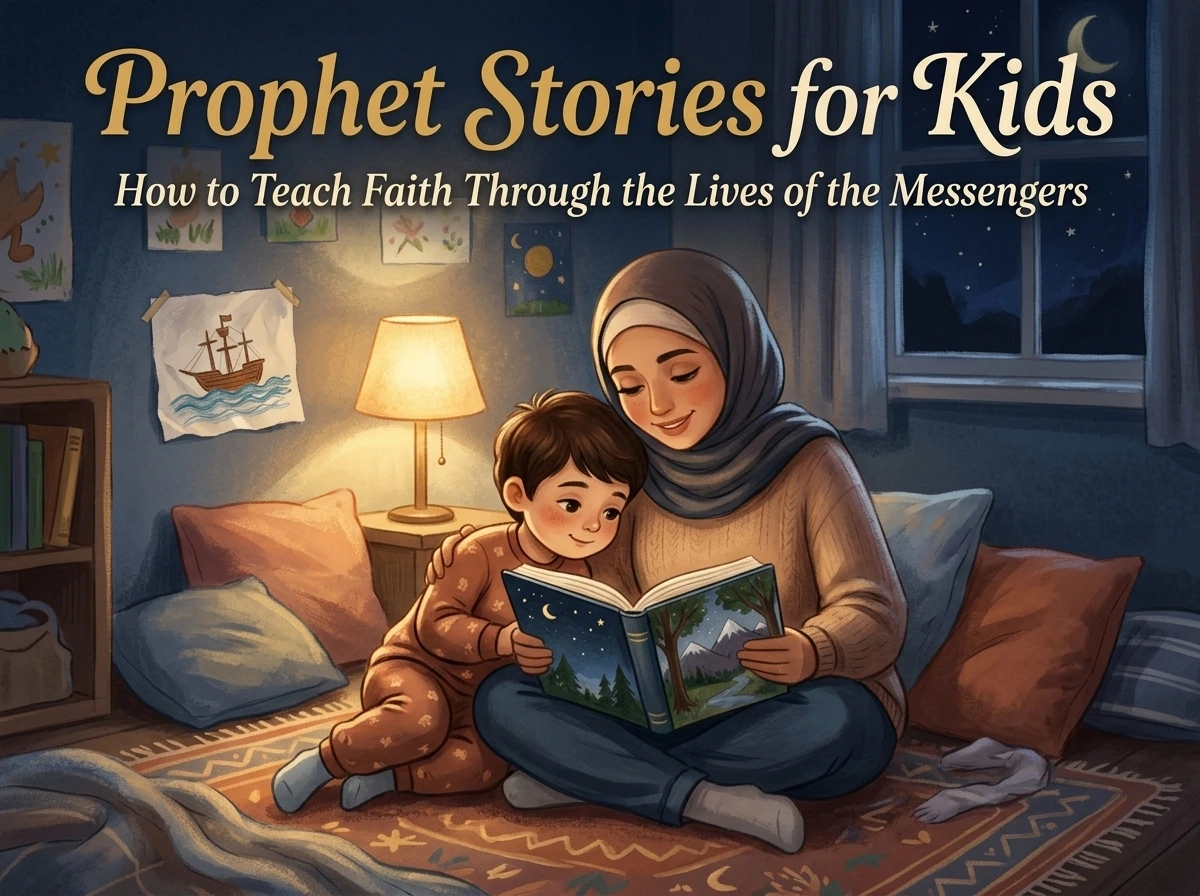
Prophet Stories for Kids
What If Bedtime Could Build Your Child’s Character for Life?
Think about the stories your child will remember at 30 years old. Chances are, they are the ones told slowly, at night, in a parent’s voice. Prophet stories for kids are among the most powerful stories a Muslim family can tell, because they carry truth, courage, patience, and mercy in a form a child can feel.
This guide shows you how to tell these stories well, which lessons to highlight, and how to match each story to your child’s age.
Introduction
Children learn values far more easily through stories than through lectures. A five-year-old may forget a rule about honesty, but will remember Prophet Yusuf (peace be upon him) trusting Allah at the bottom of a well.
Prophet stories for kids are not just entertainment. The Quran itself presents them as guidance and reminders. Allah says in Surah Yusuf that in the stories of earlier people there is a lesson for those who have understanding (12:111).
In this article, you will learn why these stories matter, how to tell them accurately, and how to turn each one into a conversation about character. You will also find age-based tips, a story-by-story lesson guide, common mistakes to avoid, and a set of simple activities.
Throughout this article, whenever a prophet is named, it is understood that we say “peace be upon him.” Teaching this habit to children from the start is itself a lesson in adab (good manners).
Why Prophet Stories Matter for Muslim Children
The prophets are the best role models humanity has ever had. They were ordinary human beings, chosen by Allah, who faced fear, rejection, loss, and hardship while staying firm in faith.
That is exactly what makes them relatable to children. A child who feels left out can learn from Prophet Nuh, who was mocked by his people. A child who feels afraid can learn from Prophet Musa, who was sent to a tyrant and trusted Allah anyway.
Here is what these stories give a child:
- A sense of identity. The child learns they belong to a long, honorable line of believers.
- Moral vocabulary. Words like patience (sabr), trust (tawakkul), gratitude (shukr), and truthfulness (sidq) become real through examples.
- Emotional resilience. Children see that hardship is normal and that Allah is always near.
- Love for Allah. The stories show His mercy, His power, and His care for His servants.
The Quran Is the Primary Source
The Quran mentions 25 prophets by name. Many of the best-known stories come directly from its verses, and the Sunnah adds further detail through authentic hadith.
This matters because a parent should tell these stories with accuracy. Children trust what you say, so it is worth making sure the details come from the Quran, authentic hadith, and reliable scholarly works rather than from invented embellishments.
How to Tell Prophet Stories to Kids the Right Way
Knowing the story is only half the work. How you tell it decides whether your child remembers it.
Start With the Lesson, Not the Plot
Before you begin, decide on one core lesson. For Prophet Ibrahim, it could be “trust Allah even when you feel alone.” Every part of your telling should lead back to that point.
Use Simple Language and a Calm Voice
Skip complicated words. Say “the king was very unkind” instead of describing tyranny in detail. Use pauses, a softer voice for sad moments, and a warmer voice for joyful ones.
Ask Questions Along the Way
Pause and ask, “What would you have done?” or “How do you think he felt?” Children engage far more when they are invited to think.
Keep It Age-Appropriate
Some events in the stories of the prophets involve death, punishment, or injustice. For younger children, focus on the hope and the lesson, and leave out frightening details. You can share more as they grow.
Connect the Story to Daily Life
After the story, link it to something your child faced today. If they were impatient, remind them of Prophet Ayyub. If they told the truth when it was hard, remind them of Prophet Yusuf.
Age-Based Guide to Prophet Stories for Kids
Not every story suits every age. Here is a practical way to choose.
Ages 3 to 5: Short, Gentle, and Visual
At this age, keep stories under five minutes and focus on one image or action.
- Prophet Adam: Allah created him and taught him the names of things. A beautiful starting point for curiosity and gratitude.
- Prophet Nuh: He built a great ship, and Allah saved the believers. Focus on obedience and kindness to animals.
- Prophet Sulaiman: He could understand ants and birds, which makes this a favorite for little ones.
Ages 6 to 8: Add Characters and Choices
Children this age can follow a sequence of events and understand cause and effect.
- Prophet Ibrahim: His honesty with his people, and how Allah protected him from the fire.
- Prophet Yunus: His time inside the whale and his sincere dua.
- Prophet Yusuf: Dreams, jealousy, forgiveness, and a happy reunion.
Ages 9 to 12: Explore Meaning and Reflection
Older children can handle complexity and enjoy discussing “why” questions.
- Prophet Musa: Courage before Pharaoh, leadership, and patience with a difficult community.
- Prophet Isa: His miraculous birth, his truthful message, and the Quranic account of his mother Maryam.
- Prophet Muhammad ﷺ: His character before and after revelation, and his mercy toward children, animals, and enemies.
Core Prophet Stories and the Lessons Children Can Learn
Below are key stories with the main lesson for each. Use them as a starting point for your own storytelling.
Prophet Adam: Gratitude and Repentance
Allah created Adam, honored him, and taught him knowledge. When Adam made a mistake, he turned to Allah in repentance, and Allah forgave him (Quran 2:37).
Lesson for kids: Everyone makes mistakes. What matters is saying sorry to Allah and trying again.
Prophet Nuh: Patience in Calling Others
The Quran tells us Nuh called his people to Allah for 950 years (Quran 29:14). Most of them refused, yet he continued with patience.
Lesson for kids: Keep doing good, even when others do not listen. Do not give up on kindness.
Prophet Ibrahim: Courage and Trust in Allah
Ibrahim questioned his people’s idols with wisdom and honesty. When he was thrown into the fire, Allah commanded it to be cool and safe for him (Quran 21:69). According to a narration in Sahih al-Bukhari, his words at that moment were “Hasbunallahu wa ni’mal wakeel,” meaning “Allah is sufficient for us, and He is the best disposer of affairs.”
Lesson for kids: When you feel scared, say these words and remember that Allah is with you.
Prophet Yusuf: Truthfulness and Forgiveness
Yusuf’s brothers were jealous, and they threw him into a well. Later he faced false accusations and prison. Through all of it, he stayed truthful and patient. When he finally met his brothers again in a position of power, he forgave them.
Lesson for kids: Jealousy hurts everyone, but forgiveness heals. Truthfulness always brings honor in the end.
Prophet Yunus: Turning Back to Allah
Yunus left his people before Allah gave him permission and found himself inside a great fish. In the darkness, he called out to Allah (Quran 21:87). Allah answered his call and rescued him.
Lesson for kids: No situation is too dark for a sincere dua. Allah always hears us.
Prophet Ayyub: Patience in Hardship
Ayyub suffered illness and loss for a long time, yet he never complained against Allah. He prayed, and Allah relieved his suffering and blessed him again (Quran 21:83 to 84).
Lesson for kids: Patience is not silence. It is trusting Allah while we ask Him for help.
Prophet Musa: Standing Up for Justice
Allah sent Musa to Pharaoh, a ruler who oppressed people. Musa spoke with courage, and when Pharaoh’s army chased the believers to the sea, Allah opened a path for them (Quran 26:63).
Lesson for kids: Standing up for what is right takes courage, and Allah helps those who trust Him.
Prophet Sulaiman: Gratitude for Blessings
Sulaiman was given a great kingdom, yet he remained humble. When he heard an ant warn her fellow ants, he smiled and thanked Allah for His favors (Quran 27:18 to 19).
Lesson for kids: Blessings are a reason to be thankful, never a reason to be proud.
Prophet Isa: Truth, Mercy, and Miracles by Allah’s Permission
Isa was born miraculously to Maryam, and he spoke as an infant to defend her honor (Quran 19:29 to 33). He called his people to worship Allah alone and performed miracles by Allah’s permission.
Lesson for kids: Allah is all-powerful, and His servants are always humble before Him.
Prophet Muhammad ﷺ: The Best Example
The Prophet Muhammad ﷺ was known as truthful and trustworthy even before revelation. He was gentle with children, kind to animals, and patient with those who harmed him.
Lesson for kids: The best way to love the Prophet ﷺ is to follow his character in our daily lives.
Also Read: Surah Taha: Meaning, Virtues, Key Themes and Lessons for Daily Life

Practical Tips for Parents and Caregivers
You do not need to be a scholar to tell prophet stories well. You need preparation, sincerity, and consistency.
Prepare Before You Tell
Read the story from a reliable source first. Many parents notice that when they prepare even five minutes in advance, their storytelling becomes calmer and more accurate.
Build a Weekly Rhythm
Choose a fixed time, such as after Fajr on weekends or before bed. A short, regular story works better than an occasional long one.
Let Children Retell the Story
Ask your child to tell it back to you in their own words. This strengthens memory and shows you what they understood.
Use Safe and Respectful Visuals
Islamic tradition avoids depicting the faces or forms of the prophets. Instead, use drawings of the setting, such as a ship, a well, a desert, or a night sky. This protects your child’s respect for the prophets from the beginning.
Pair Each Story With a Dua or Quranic Verse
When appropriate, teach one short phrase from the story. For Yunus, it could be the dua from Surah al-Anbiya. For Ibrahim, it could be “Hasbunallahu wa ni’mal wakeel.”
Simple Activities to Reinforce Prophet Stories for Kids
Stories stay in the heart longer when children can do something with them.
- Draw the scene: Ask your child to draw the setting, such as the ark, the well, or the sea.
- Lesson jar: Write one lesson from each story on a slip of paper and place it in a jar. Read one each week.
- Character of the week: Choose one quality, such as patience or truthfulness, and look for chances to practice it.
- Story timeline: Make a simple chain of paper links, one for each prophet you have learned about.
- Role-play the good choice: Act out a modern situation, such as a friend being unkind, and talk about how a prophet would respond.
Common Mistakes to Avoid When Telling Prophet Stories
A few small mistakes can weaken an otherwise great story time. Keep these in mind.
- Adding unverified details. Some popular retellings include events that are not in the Quran or authentic hadith. When unsure, stay with what is clearly established.
- Making the prophets seem like superheroes. They were human beings who relied fully on Allah. Emphasize reliance on Allah, not personal power.
- Overusing fear. Stories of punishment exist, but children first need to know Allah’s mercy, love, and care.
- Skipping the lesson. A story without reflection is just a tale. Always close with a question or a takeaway.
- Forgetting the honorific. Say “peace be upon him” after each name, and encourage your child to do the same.
Key Takeaways
- Prophet stories for kids are one of the most effective ways to build faith and character.
- Always rely on the Quran and authentic hadith for accuracy.
- Match each story to your child’s age and emotional readiness.
- Start with one clear lesson and connect it to daily life.
- Use questions, drawings, and simple activities to make stories stick.
- Avoid images of the prophets, and teach respect through the honorific.
Conclusion
The best gift you can give your child is a love for Allah and a role model to follow. Prophet stories for kids offer both in a way that is warm, memorable, and deeply rooted in revelation.
You do not need to tell perfect stories. You need to tell true ones, with sincerity and a clear lesson. Begin tonight with one short story, ask one thoughtful question, and watch how your child responds.
Over time, these small moments build a child who knows the prophets, loves them, and strives to live by their example.
Sources and Official References
- The Holy Quran (Surahs al-Baqarah, al-Anbiya, an-Naml, Yusuf, Maryam, ash-Shu’ara, al-Ankabut): https://quran.com
- Sahih al-Bukhari: https://sunnah.com/bukhari
- Sahih Muslim: https://sunnah.com/muslim
- Jami at-Tirmidhi: https://sunnah.com/tirmidhi
- Tafsir Ibn Kathir: https://quran.com/1:1/tafsirs/en-tafisr-ibn-kathir
- Qasas al-Anbiya by Ibn Kathir (Stories of the Prophets): https://archive.org/search?query=Stories+of+the+Prophets+Ibn+Kathir
Frequently Asked Questions
1. At what age should I start telling prophet stories to my child?
You can begin as early as age 3, using very short and gentle versions. Start with stories like Prophet Adam, Prophet Nuh, or Prophet Sulaiman, and add more detail as your child grows.
2. Which prophet story is best for a first-time listener?
Many parents begin with Prophet Nuh or Prophet Sulaiman, because the images of a great ship and a kingdom that includes animals capture a young child’s attention. The lessons of obedience and gratitude are also simple to grasp.
3. How many prophets are mentioned in the Quran?
The Quran mentions 25 prophets by name. Muslims believe Allah sent many more messengers to every nation, but only these are named in the Quran.
4. Is it acceptable to use pictures or cartoons of the prophets in children’s books?
Many scholars advise against depicting the prophets in images or animations out of respect. A safer approach is to use illustrations of the surroundings, such as a ship, a well, or a night sky, and let the child imagine the rest.
5. How can I help my child remember the lessons from prophet stories?
Ask your child to retell the story, connect it to a real situation from their day, and practice one related quality for a week. Repetition and reflection help the lesson move from the mind into daily behavior.
Disclaimer: This article is provided for educational and informational purposes only and reflects general Islamic scholarly perspectives on Surah Yaseen. It is not a substitute for guidance from a qualified Islamic scholar or certified religious authority. For matters of hadith authenticity, personal practice, or specific religious rulings, please consult a certified professional in Islamic studies.
