Religion of the Muslim: The Complete Guide to Islam’s Core Beliefs
The Second Largest Faith on Earth, Explained Simply
When people search for the religion of the muslim, they are usually looking for one thing: a clear, accurate explanation of what Islam actually teaches, without the confusion that often surrounds it online. With roughly 2 billion followers worldwide, understanding this faith accurately matters more than ever.
I started researching the religion of the muslim in depth after noticing how many basic explanations online skip the actual structure of belief and jump straight into cultural stereotypes. What became clear through that research is that Islam has a remarkably organized theological framework, built around clear pillars of practice and core articles of faith that any beginner can follow.
This guide breaks down what the religion of the muslim actually teaches, its core practices, its global reach, and the most common questions people ask about it.
What Is the Religion of the Muslim Best Known For?
The religion of the muslim is Islam, a monotheistic faith centered on belief in one God (Allah) and the teachings revealed through Prophet Muhammad in the Quran. It is best known for the Five Pillars of practice, the Six Articles of Faith, and its global reach of roughly 2 billion followers, making it the world’s second largest religion.
What Does the Word “Muslim” Actually Mean?
Before understanding the religion of the muslim, it helps to understand the word itself. “Muslim” comes from the Arabic root “salama,” meaning peace or submission, and it literally translates to “one who submits” to the will of God.
Islam, the name of the religion, comes from the same root, meaning “submission” or “surrender” in a spiritual sense. This is one of the more commonly misunderstood points I encountered during research, since many assume the terms Islam and Muslim are unrelated words rather than variations of the same Arabic root.
How Many People Follow the Religion of the Muslim Worldwide?
According to a 2025 demographic report by Pew Research Center, one of the most respected nonpartisan research organizations tracking global religious demographics, the global Muslim population grew 21% between 2010 and 2020, rising from 1.7 billion to 2.0 billion people. Muslims grew twice as fast as the rest of the world’s population during that decade, increasing their share of the global population from 24% to 26%.
This makes Islam the second largest religion in the world after Christianity, and by several demographic projections, it is on track to become the world’s largest religion within this century if current growth trends continue.
What Are the Core Beliefs of the Religion of the Muslim?
The theological foundation of the religion of the muslim rests on six core articles of faith, often referred to as “Iman” (belief). These are not optional add ons; they form the structural backbone of what a Muslim is expected to believe.
- Belief in one God (Tawheed): The absolute core of Islamic theology, rejecting any form of polytheism.
- Belief in angels: Unseen beings created by Allah to carry out specific divine tasks.
- Belief in revealed scriptures: Including the Quran, along with earlier scriptures given to previous prophets.
- Belief in the prophets: A chain of messengers beginning with Adam and ending with Muhammad.
- Belief in the Day of Judgment: Accountability for actions in the afterlife.
- Belief in divine decree (Qadar): Acceptance that Allah has knowledge and authority over all events.
This structure is documented extensively on Quran.com, a leading digital Quran platform offering translations, tafsir, and scholarly commentary in more than 100 languages, which cross references these beliefs directly to their source verses.
How Is the Religion of the Muslim Practiced Daily?
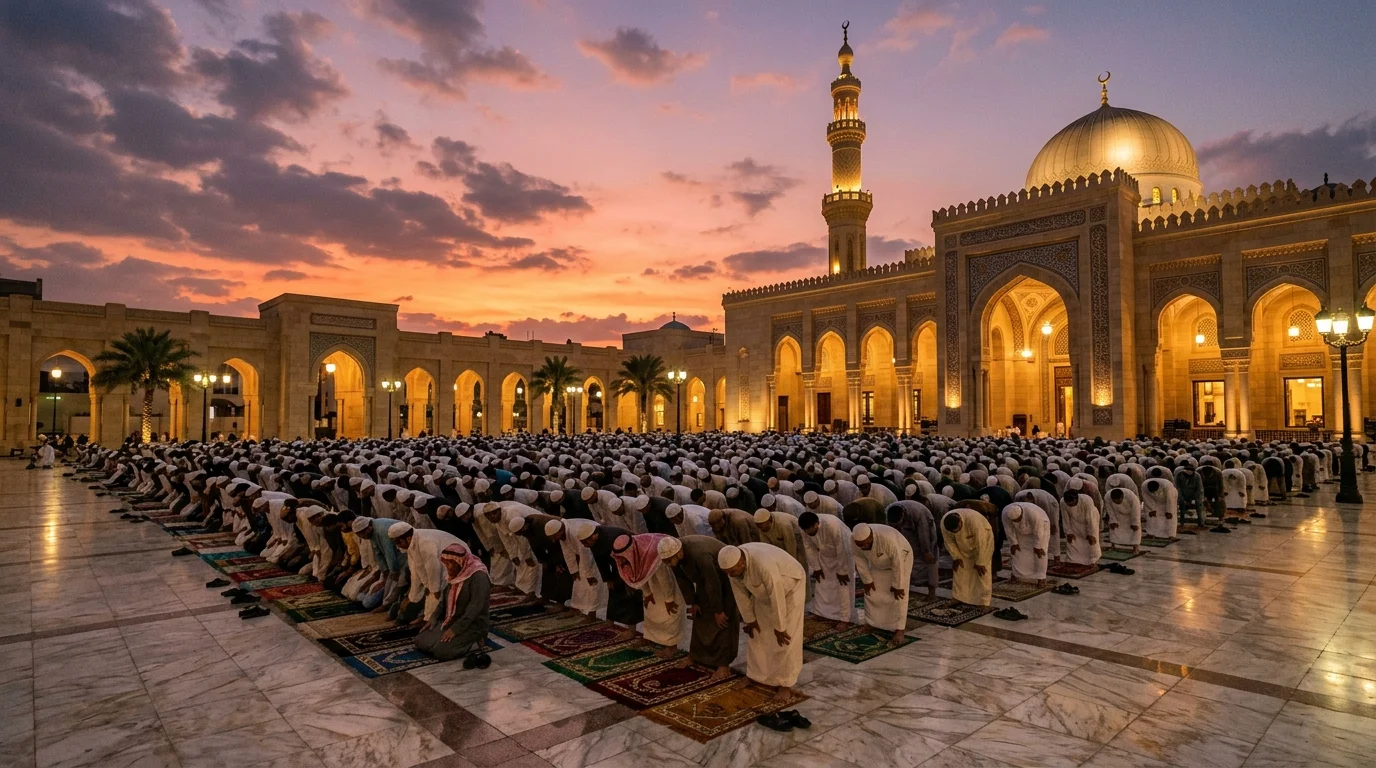
Practice within the religion of the muslim centers on the Five Pillars of Islam, which structure daily, weekly, and lifetime religious obligations.
- Shahada (Declaration of Faith): Testifying that there is no god but Allah and Muhammad is His messenger.
- Salah (Prayer): Performed five times daily at prescribed times, facing the direction of the Kaaba in Makkah.
- Zakat (Charity): A mandatory charitable contribution, typically calculated at 2.5% of eligible savings annually.
- Sawm (Fasting): Abstaining from food, drink, and other physical needs from dawn to sunset during the month of Ramadan.
- Hajj (Pilgrimage): A once in a lifetime pilgrimage to Makkah, required for those who are physically and financially able.
Who Founded the Religion of the Muslim?
Muslims believe the religion of the muslim was not founded by a human being in the conventional sense, but rather revealed by Allah through a chain of prophets, with Muhammad as the final messenger. According to Islamic belief, the core message, submission to one God, was the same message delivered to earlier prophets like Abraham, Moses, and Jesus.
When Did Islam Begin as an Organized Faith?
The formal organization of the religion of the muslim as a structured community began in the early 7th century CE, when Prophet Muhammad received his first revelation in 610 CE near Makkah. The faith spread rapidly across the Arabian Peninsula and beyond within just a few decades of his death in 632 CE.
According to hadith literature preserved on Sunnah.com, a widely referenced repository of authenticated hadith texts used by Islamic researchers and students, the Prophet Muhammad emphasized that this faith was a continuation and completion of earlier monotheistic teachings, not an entirely separate invention.
What Are the Major Branches Within the Religion of the Muslim?
Like most major world religions, the religion of the muslim includes distinct branches that developed over history, primarily due to disagreements over leadership succession after the Prophet’s death.
- Sunni Islam: The largest branch, representing roughly 85 to 90% of the global Muslim population.
- Shia Islam: The second largest branch, representing roughly 10 to 15% of Muslims globally, concentrated heavily in Iran, Iraq, Pakistan, and Bahrain.
- Smaller sects and movements: Including Sufism (a mystical tradition found across both major branches), Ibadi Islam, and various reform movements.
This sectarian distribution is documented in demographic research published by Pew Research Center, based on data collected across more than 200 countries and territories.
Actionable Tips for Learning About the Religion of the Muslim Respectfully
If you are researching this topic for academic, personal, or professional reasons, these steps improve accuracy and cultural sensitivity.
- Start with primary sources rather than secondhand summaries. Reading directly from the Quran or authenticated hadith collections avoids distortion introduced by unreliable secondary commentary.
- Distinguish between cultural practice and religious requirement. Many practices attributed to the religion of the muslim are regional customs rather than actual religious obligations.
- Avoid generalizing based on any single country or community. With followers across more than 200 countries, practice and interpretation vary significantly by region.
- Ask direct questions to practicing Muslims when possible. Firsthand explanation often clarifies misconceptions faster than secondhand research.
- Cross check statistics against recognized research organizations. Demographic claims about Islam vary widely online, so relying on established sources like Pew Research Center improves accuracy.
Common Misunderstandings About the Religion of the Muslim
A few misconceptions come up repeatedly in casual conversation and online searches.
- Misconception: All Muslims are Arab or come from the Middle East. Reality: The Asia-Pacific region is home to the largest Muslim population globally, with Indonesia alone having more Muslims than the entire Middle East combined.
- Misconception: Islam is a monolithic religion practiced identically everywhere. Reality: Significant variation exists across Sunni, Shia, and other branches, as well as across cultural regions.
- Misconception: The religion was invented separately from Judaism and Christianity. Reality: Islamic theology presents itself as a continuation of the same monotheistic prophetic tradition, referencing earlier prophets recognized in both Judaism and Christianity.
Final Thoughts on the Religion of the Muslim
Understanding the religion of the muslim requires moving past surface level assumptions and engaging with its actual theological structure: one God, a chain of prophets, six articles of belief, and five practical pillars that shape daily and lifelong worship. With close to 2 billion adherents and continued rapid growth, it remains one of the most influential belief systems shaping the modern world.
Whether you are researching this topic for academic purposes, personal curiosity, or interfaith understanding, grounding your knowledge in primary sources and credible demographic research produces a far more accurate picture than casual assumptions ever could.
Also Read: Read Quran Online With Tajweed: The Complete Beginner to Advanced Guide
FAQs
1. What is the religion of the muslim called?
The religion of the muslim is called Islam, meaning submission to God. A follower of Islam is referred to as a Muslim, which translates to “one who submits.”
2. How many people practice the religion of the muslim today?
As of 2020, roughly 2 billion people practice Islam worldwide, making it the world’s second largest religion after Christianity. This represents about 26% of the global population, according to Pew Research Center.
3. What are the main beliefs in the religion of the muslim?
The religion of the muslim is built on six core articles of faith: belief in one God, angels, revealed scriptures, prophets, the Day of Judgment, and divine decree. These beliefs are supported through daily practice known as the Five Pillars of Islam.
4. What is the difference between Sunni and Shia in the religion of the muslim?
Sunni Islam represents roughly 85 to 90% of Muslims globally, while Shia Islam represents about 10 to 15%. The split originated from a historical disagreement over leadership succession after the Prophet Muhammad’s death.
5. Who is considered the founder of the religion of the muslim?
Muslims believe Islam was not founded by a human but revealed by Allah through the Prophet Muhammad, who received the first revelation in 610 CE. Islamic theology considers this a continuation of the same message given to earlier prophets like Abraham, Moses, and Jesus.
Sources and Official References
Quran.com: https://quran.com
Sunnah.com: https://sunnah.com
Pew Research Center, “How the Global Religious Landscape Changed From 2010 to 2020”: https://www.pewresearch.org/religion/muslim-population/
Pew Research Center, “Islam was the world’s fastest-growing religion from 2010 to 2020”: https://www.pewresearch.org/short-reads/2025/06/10/islam-was-the-worlds-fastest-growing-religion-from-2010-to-2020/
Disclaimer: This article is provided for educational and informational purposes only and offers a general overview of Islamic beliefs and practices. It is not a substitute for guidance from a qualified Islamic scholar or religious authority. For matters of personal faith or specific religious rulings, please consult a certified professional in Islamic studies.
