Surah Fatiha: The Opening Chapter Every Muslim Prays 17 Times a Day
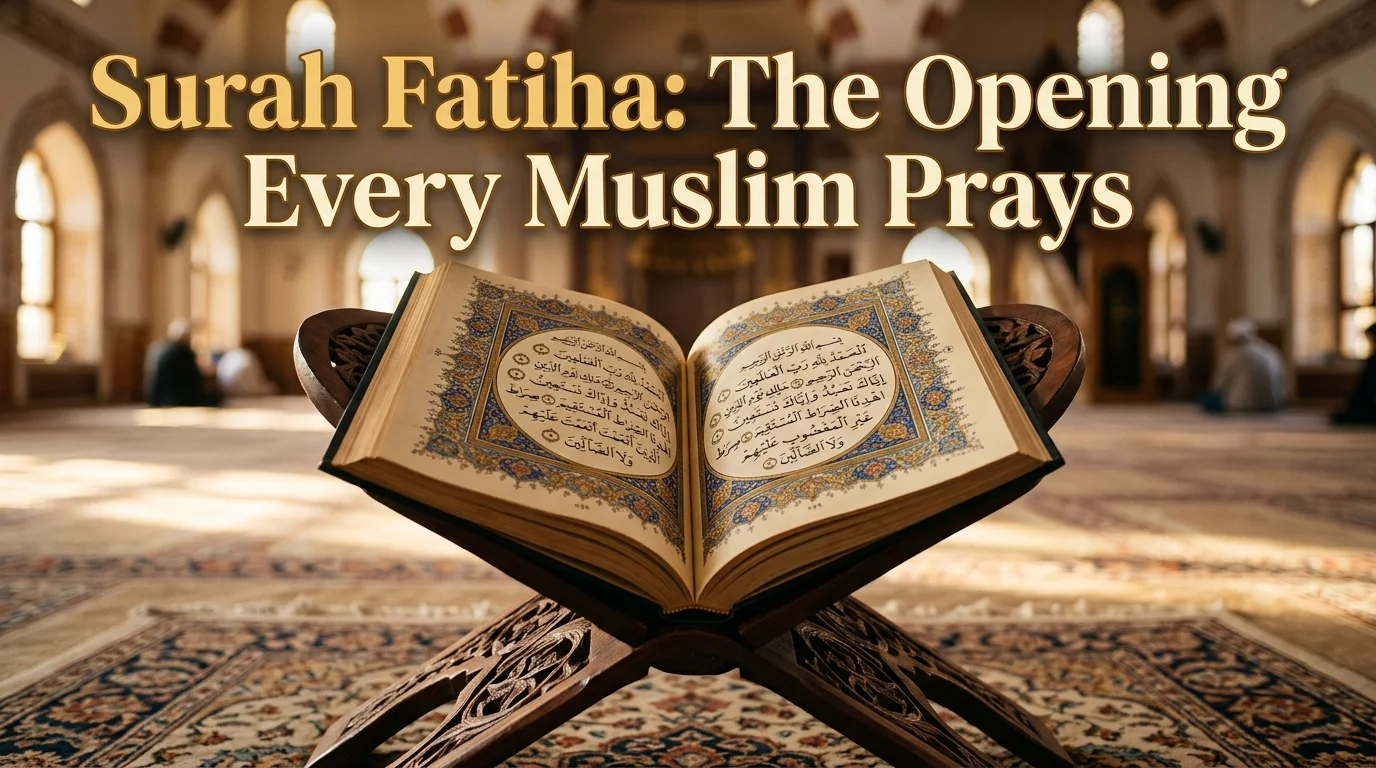
The Seven Verses That Open Every Single Prayer
Ask any Muslim what the most repeated chapter in their daily life is, and the answer is almost always the same: Surah Fatiha. It is recited in every single unit (rakah) of the five daily prayers, which means most practicing Muslims recite it well over a dozen times before the day is even over.
I started digging deeper into Surah Fatiha after noticing how often new Muslims struggle to memorize it correctly in their first few weeks of learning to pray. What seemed like a simple seven line chapter turned out to carry an entire theological framework, one that scholars have unpacked for over a thousand years.
This guide walks through the meaning, structure, revelation history, and daily application of Surah Fatiha, along with practical tips for learning it correctly.
What Is Surah Fatiha Best Known For?
Surah Fatiha is the opening chapter of the Quran, consisting of 7 verses recited in every unit of the five daily Muslim prayers. Known as “The Opening” and “Umm al Kitab” (Mother of the Book), it summarizes the Quran’s core themes: praise of Allah, guidance, and a direct plea for the straight path.
The Meaning and Name of Surah Fatiha
The Arabic word “Fatiha” translates to “The Opening” in English. It earns this name simply by being the first chapter placed at the beginning of the Quran’s written arrangement (mushaf), even though it was not the first chapter revealed chronologically.
Surah Fatiha carries several additional names in Islamic tradition, including “Umm al Kitab” (Mother of the Book), “As Sab al Mathani” (The Seven Oft Repeated Verses), and “Surah al Hamd” (The Chapter of Praise). Each name reflects a different aspect of its role, whether structural, recitational, or thematic. This layered naming convention is discussed extensively on (cite index=”0-0″>Quran.com, a leading digital Quran platform offering translations and tafsir in more than 100 languages</cite>.
How Many Verses Does Surah Fatiha Contain?
Surah Fatiha contains exactly 7 verses, 29 words, and 139 letters according to traditional Quranic manuscript counts. Scholars note that this number, seven, is directly referenced in the Quran itself as “the seven oft repeated verses” (Surah Al Hijr, verse 87).
Was Surah Fatiha Revealed in Makkah or Madinah?
Surah Fatiha is classified as a Makkan surah, meaning it was revealed to the Prophet Muhammad (peace be upon him) before his migration to Madinah. Many scholars consider it among the earliest complete chapters revealed, given its foundational role in establishing the structure of Muslim prayer.
The Historical and Spiritual Significance of Surah Fatiha
According to hadith literature preserved on (cite index=”0-1″>Sunnah.com, a widely used repository of authenticated hadith texts referenced by Islamic researchers and students</cite>, the Prophet Muhammad described Surah Fatiha as the greatest chapter in the Quran. One well known hadith states that no other book, whether the Torah, the Gospel, or the Quran itself outside this chapter, contains anything comparable to it.
This is the part of my research that reframed how I understood the surah. It is not simply an introduction; it functions as a direct conversation between the worshipper and Allah, with tradition holding that Allah responds to each verse as the servant recites it.
Why Is Surah Fatiha Required in Every Prayer?
Islamic jurisprudence considers the recitation of Surah Fatiha a mandatory pillar (rukn) of valid prayer according to the majority of scholarly schools of thought. A prayer performed without reciting it is generally considered invalid, based on a hadith stating there is no prayer for the one who does not recite the Opening of the Book.
Breaking Down Each Verse of Surah Fatiha
Understanding the surah verse by verse reveals its structure as a complete dialogue.
- Verse 1: “In the name of Allah, the Most Gracious, the Most Merciful,” establishing the tone of mercy before anything else.
- Verse 2: “All praise is due to Allah, Lord of all the worlds,” opening with pure praise and acknowledgment.
- Verse 3: Repeats the attributes of mercy, reinforcing Allah’s compassionate nature.
- Verse 4: “Master of the Day of Judgment,” introducing accountability and the concept of the afterlife.
- Verse 5: “It is You we worship and You we ask for help,” marking the shift from praise to direct address.
- Verse 6: “Guide us to the straight path,” the central request of the entire chapter.
- Verse 7: Describes the path of those blessed by Allah, distinct from those who earned His anger or went astray.
What Does “The Straight Path” Mean in Surah Fatiha?
The phrase “straight path” (as sirat al mustaqim) refers to the path of guidance, truth, and righteousness as demonstrated by the prophets and righteous people throughout history. Commentators like Ibn Kathir explain this as the core request of the surah: a plea for consistent guidance in belief and action, not a one time favor.
How Is Surah Fatiha Used in Daily Muslim Practice?
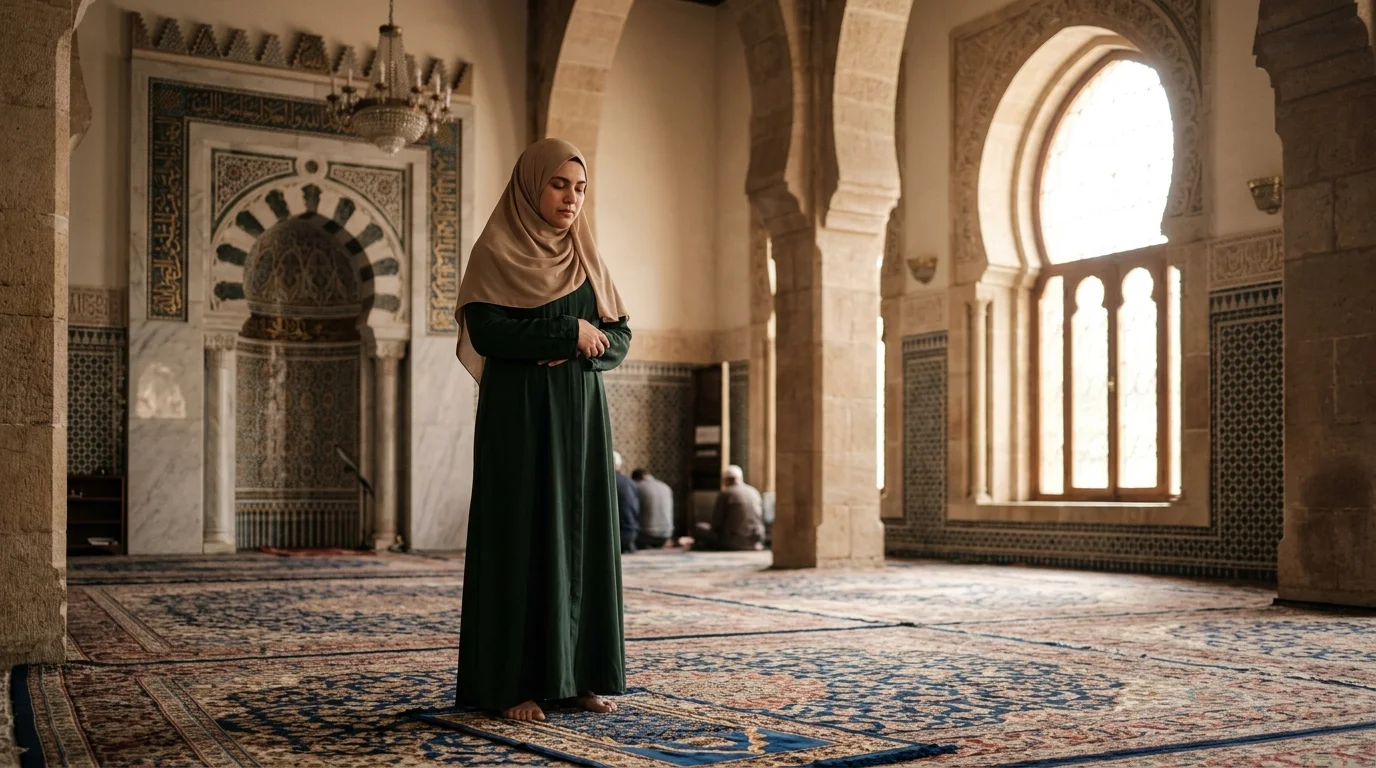
Based on observing prayer routines across different Muslim communities, Surah Fatiha appears in several consistent, practical contexts beyond the five daily prayers:
- Opening supplications (duas): Many Muslims recite it before making personal requests to Allah, treating it as a spiritual opening statement.
- Funeral prayers: It is recited as part of the funeral prayer (salat al janazah) structure.
- Ruqyah and healing practices: Some hadith scholars document its use in early Islamic history as a means of spiritual healing.
- Teaching new Muslims: It is almost always the first chapter taught to converts, since it is required before they can pray validly.
This consistent daily repetition is one reason (cite index=”0-2″>Al Azhar University, one of the oldest and most authoritative centers of Islamic learning in the world</cite>, places heavy emphasis on correct tajweed (pronunciation rules) specifically for this chapter in its foundational Quran curriculum.
Can Non Arabic Speakers Recite Surah Fatiha in Their Own Language?
The overwhelming majority scholarly position holds that valid prayer requires reciting Surah Fatiha in its original Arabic form, regardless of the worshipper’s native language. Translations are used for understanding meaning, but Arabic recitation remains a requirement for the prayer itself according to mainstream Islamic jurisprudence.
Actionable Tips for Learning and Reciting Surah Fatiha Correctly
If you are memorizing this chapter for the first time, or refining your recitation, these steps genuinely speed up the process:
- Learn the meaning before memorizing word for word. Understanding that verses 2 through 4 are praise, verse 5 is a pledge, and verses 6 through 7 are a request, makes memorization far more intuitive.
- Focus on the “th,” “dh,” and “ain” sounds first. These Arabic letters do not exist in English and are the most commonly mispronounced sounds in this specific surah.
- Practice with a certified tajweed teacher for at least the first two weeks. Self correction often misses subtle elongations (madd) that change the meaning of certain words.
- Record your own recitation and compare it to a certified reciter. This single habit catches more pronunciation errors than passive listening alone.
- Recite it slowly during prayer rather than rushing. Since it must be repeated in every unit, rushing becomes a habit that is hard to unlearn later.
Common Misunderstandings About Surah Fatiha
A few misconceptions come up repeatedly among new learners and online forums:
- Misconception: It is only a short introductory chapter with minimal theological content. Reality: Scholars consider it a complete summary of the Quran’s core themes, including monotheism, mercy, accountability, and guidance.
- Misconception: Any short chapter can substitute for it in prayer. Reality: The majority of scholarly schools require specifically Surah Fatiha for a prayer to be considered valid.
- Misconception: Its meaning is only relevant during formal prayer. Reality: Many Muslims recite it during personal reflection, before major decisions, or during moments of gratitude outside of formal salah.
Final Thoughts on Surah Fatiha
Surah Fatiha may only span seven verses, but its placement as the Quran’s opening chapter and its mandatory role in daily prayer make it one of the most repeated pieces of scripture in the world. Understanding its structure, from praise to plea, transforms it from a memorized routine into a genuinely reflective practice.
Whether you are new to Islamic prayer, a student of Arabic, or simply researching Surah Fatiha out of curiosity, understanding its deeper structure adds real meaning to something recited multiple times every single day.
Also Read: Al Naas Surah: The Complete Guide to Islam’s Final Chapter of Protection
FAQs
1. What does Surah Fatiha mean in English?
Surah Fatiha translates to “The Opening.” It is the first chapter of the Quran and is recited in every unit of the five daily Muslim prayers as a required pillar of valid prayer.
2. How many verses are in Surah Fatiha?
Surah Fatiha contains exactly 7 verses. It is also referred to in the Quran itself as “the seven oft repeated verses” due to its constant recitation in daily prayer.
3. Why is Surah Fatiha recited in every prayer?
Surah Fatiha is considered a mandatory pillar of Islamic prayer according to the majority of scholarly schools. A hadith states that prayer without reciting it is not considered valid.
4. Can I recite Surah Fatiha in English instead of Arabic during prayer?
The mainstream scholarly position requires Surah Fatiha to be recited in its original Arabic form for prayer to be valid. Translations can be used to understand its meaning outside of formal prayer.
5. What is the difference between Surah Fatiha and other short surahs?
Surah Fatiha is specifically required in every unit of prayer, unlike other short chapters which are optional additions. It also functions as a complete summary of the Quran’s core themes, including praise, mercy, and guidance.
Sources and Official References
Quran.com: https://quran.com
Sunnah.com: https://sunnah.com
Al-Azhar University (Al-Azhar Al-Sharif): https://www.azhar.eg
Disclaimer: This article is provided for educational and informational purposes only and reflects general Islamic scholarly perspectives on Surah Fatiha. It is not a substitute for guidance from a qualified Islamic scholar, imam, or certified religious authority. For matters of prayer validity, tajweed, or specific religious rulings, please consult a certified professional in Islamic studies.
