What Age Should a Child Start Learning Quran Online? The Honest Answer Every Parent Needs

The Question That Keeps Parents Up at Night
What age should a child start learning Quran online? It is one of the first big parenting decisions many Muslim families face, and it rarely feels simple.
Start too early and you risk a tearful three-year-old who now associates the Quran with frustration. Wait too long and you worry you have let the easiest learning years slip by.
I have sat through this exact dilemma with my own nephew. We tried a group class at three and a half, and within two weeks he was hiding behind the sofa the moment the laptop opened. Six months later, with a one-to-one teacher and five-minute sessions, he was proudly repeating Arabic letters on his own. The age was almost the same. What changed was the approach.
This guide answers the question properly: the ideal starting age, the real signs of readiness, what child development research actually says, and how to build a routine that sticks.
What Age Should a Child Start Learning Quran Online? (Quick Answer)
Four to six years old is generally the ideal age to start learning Quran online. At this age, children typically focus for eight to fifteen minutes, imitate sounds accurately, and follow simple instructions. Three-year-olds can also begin, with short, playful sessions built around love for the Quran rather than speed.
That is the direct answer. Now let’s look at the reasoning, the research, and the practical steps behind it.
Why Does Four to Six Years Old Work So Well for Quran Learning?
Between four and six, children go through a burst of language development that makes them unusually good at picking up new sounds, including the Arabic letters and makharij (articulation points) that Quran reading depends on.
This is not just anecdotal. Research on the Critical Period Hypothesis in language acquisition, examined in a peer reviewed study published through Cambridge Core, points to early childhood as a stage when the brain is especially receptive to new phonological input, with linguistic outcomes generally stronger the earlier structured exposure begins. That research focuses on second language acquisition broadly, but the same principle of early phonological sensitivity applies directly to a child learning to recognize and reproduce Arabic letter sounds for the first time.
In simple terms: a four to six year old brain is built to absorb new sounds quickly, which is exactly what early Quran learning, starting with letter recognition and simple joining, requires.
How Long Can a Child Actually Focus in a Quran Class?
Attention span is the practical limit that decides how a lesson should be structured, and it is directly tied to age.
According to guidance referenced by the American Academy of Child and Adolescent Psychiatry (AACAP), a widely used clinical rule of thumb is that children can sustain focused attention for roughly two to five minutes per year of age, with four to five year olds typically managing eight to fifteen minutes on an engaging task.
That maps almost exactly onto what a good introductory Quran class looks like:
- Ages 3 to 4: five to ten minute sessions, letter sounds, short duas
- Ages 4 to 6: 15 to 30 minute one-to-one sessions, Noorani Qaida basics
- Ages 6 to 9: 30 minute sessions, fluent reading with Tajweed
- Ages 9 and up: 30 to 45 minute sessions, reading plus early memorization (Hifz)
If a class runs longer than a child’s natural attention span, the extra minutes are rarely productive. A calmer 15-minute session beats a frustrating 40-minute one every time.
How Do You Know Your Child Is Actually Ready?
Age is only a guide. Readiness is what actually matters, and it looks the same whether your child is three or seven. Look for these three signs:
- They can sit for 10 to 15 minutes without needing to get up repeatedly.
- They can repeat a sound or short word immediately after you say it.
- They can follow a one-step instruction, such as “point to this letter” or “say it after me.”
If your child shows two or three of these signs, they are ready to start, regardless of the exact birthday on the calendar. If they are not there yet, that is completely normal. Begin with five-minute sessions and let the attention span grow naturally over a few weeks.
Is It Too Late to Start at 7, 9, or Even 12?
No, and this is worth saying clearly because so many parents worry unnecessarily about missing a window.
Older children who start later often progress faster in raw reading speed because they can focus for longer stretches and understand multi-step instructions immediately. What they sometimes need more support with is confidence, since a nine-year-old may feel self-conscious making mistakes in a way a four-year-old simply does not.
The real risk of waiting is not academic. It is emotional. The longer a child goes without any connection to the Quran, the more it can start to feel unfamiliar rather than natural. Starting at any age with a warm, patient teacher solves this.
What Does the Research Say About Early Screen-Based Learning?
Since online Quran classes involve a screen, it is fair to ask whether that changes anything for very young children.
The American Academy of Pediatrics recommends limiting screen use for children aged two to five to one hour per day of high-quality, adult-supervised programming, while advising against screen media for children younger than 18 months except for video-chatting.
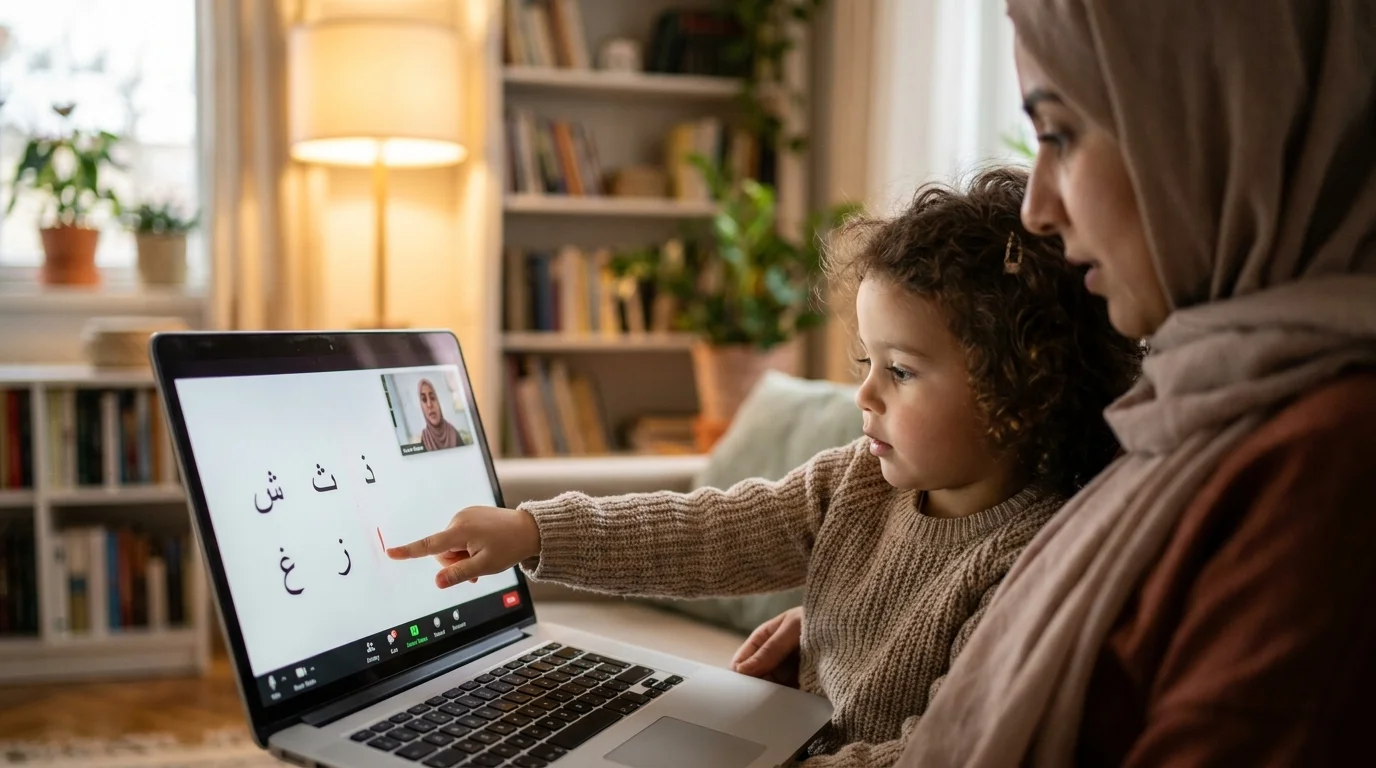
A live, one-to-one online Quran class fits comfortably within these guidelines because it is interactive rather than passive. A child is speaking, listening, and responding in real time with a teacher, which is fundamentally different from watching a video. Sitting with your child during the first few sessions also keeps the experience supervised and social, exactly as the AAP recommends for this age group.
Why Do Young Children Learn Better One-to-One Than in Groups?
A shy four-year-old in a group of six can disappear into the background within minutes. Online, that is even easier: the camera turns off, attention drifts, and the teacher has no way to gently pull them back in.
One-to-one changes that completely. The teacher notices the exact moment focus slips and can adjust immediately with a question, a game, or a short break. Pace also becomes personal, so a fast learner moves ahead without waiting, and a nervous beginner gets more repetition without feeling rushed in front of peers.
Personal observation: with my nephew, the group setting meant the teacher had four other children to manage and simply could not catch the moment his attention wandered. In the one-to-one class, the teacher noticed within seconds and turned the letter drill into a quick game. That single change is what made the difference.
Which Quran Course Should a Young Child Start With?
The right starting point depends entirely on what your child already knows.
Complete beginners with no letter recognition should start with a Noorani Qaida course, which builds the individual Arabic letters, their sounds, and simple joining rules that every later stage depends on.
Children who can read basic words move on to Nazra Quran reading with correct Tajweed, focusing on fluent, accurate recitation.
Children who enjoy repetition and want to memorize can progress to a Hifz (memorization) course once their reading is steady, while stronger readers can refine pronunciation further through advanced Tajweed study.
Alongside reading, short daily duas and simple Islamic studies lessons help keep the experience well rounded rather than purely academic.
Actionable Tips for Starting Your Child’s Quran Journey the Right Way
- Start with five to ten minute sessions, even for a six-year-old, and extend the time only once focus is consistent.
- Choose a one-to-one teacher over a group class for any child under seven, since individual attention directly addresses the attention span limits discussed above.
- Sit with your child for the first several sessions. Your calm presence signals safety, which matters more than any teaching technique in the first weeks.
- Pick a consistent time of day, ideally when your child is rested and fed, not right before a nap or after a long day at school.
- Stop the session while your child is still enjoying it. Ending on a high note builds anticipation for the next class rather than dread.
- Prioritize a patient, encouraging teacher over a strict one. Correct Tajweed comes from consistent correction over time, not pressure in the first month.
- Track small wins out loud (“you got that letter sound perfectly”), since specific praise reinforces behavior far more than generic encouragement.
- Request a trial class before committing to a full plan, so you can observe how your specific child responds to that specific teacher’s pace and style.
Does Starting Age Affect Tajweed and Pronunciation Later On?
Younger children often pick up correct pronunciation more naturally, since they copy sounds without overthinking them the way older learners sometimes do.
That said, correct Tajweed depends far more on the quality and consistency of the teacher than on the exact starting age. A trained teacher listens closely and corrects the makharij, the precise articulation points for each letter, from the very first lessons, regardless of whether the student is four or fourteen.
So while an early start offers a natural advantage in accent and sound imitation, clean recitation ultimately comes from steady, corrected practice with a qualified teacher, not from hitting a particular birthday.
What If My Child Struggles to Sit Still?
Plenty of young children wriggle, look away, or lose interest within a few minutes, and this is developmentally normal, not a sign that a child is behind or unsuited to learning.
The fix is rarely a longer class. It is usually a shorter, warmer one. Begin with five minutes and stop while your child is still engaged rather than pushing to a fixed time limit. A patient teacher who uses small games, praise, and short breaks will keep a wandering four-year-old far more engaged than a rigid 30-minute structure ever could.
The Quran itself contains 114 chapters, known as surahs, of widely varying length, as documented by Harvard University’s Pluralism Project. Your child does not need to rush through any of it. A gentle, well-paced start now is what builds a confident, lifelong reader, no matter what age should a child start learning Quran in your particular family.
Also Read: What to Wear for Umrah: The Complete Ihram and Packing Guide
Frequently Asked Questions About Starting Quran Lessons
How much time does it realistically take before a young child can read independently?
Most four to six year olds who attend consistent one-to-one sessions two to three times a week complete the Noorani Qaida stage in roughly three to six months. Independent reading confidence usually follows another few months of steady Nazra practice, though pace varies with each child’s attention span and consistency.
Do free trial classes actually show how my child will perform long term?
A single trial class mainly shows whether your child is comfortable with a specific teacher’s style and pace, which matters more for long term success than most parents expect. It will not fully predict reading speed, but a relaxed, engaged child in the trial is a strong early signal.
Is it better to start with a male or female teacher for a young child?
The teacher’s gender matters far less than their patience and ability to hold a young child’s attention, so choose based on your family’s comfort and any religious preference regarding a female student’s teacher. Many families simply request whichever teacher their child responds to best after the trial.
Can two siblings of different ages share the same Quran class to save time?
It is possible for a quick dua or Islamic studies session, but for core letter and Tajweed learning, siblings of different ages usually progress faster with separate one-to-one classes matched to their individual pace. A shared class often means the younger child is rushed or the older child is held back.
What should I do if my child cries or refuses during the first few online sessions?
This is common in the first week and usually settles once the routine feels familiar, so stay calm, keep the session short, and sit beside your child rather than leaving them alone with the screen. If resistance continues past two or three weeks, switching teachers or shortening sessions further usually resolves it.
Sources and Official References
Cambridge Core, “Critical periods for language acquisition: New insights with particular reference to bilingualism research”: https://resolve.cambridge.org/core/services/aop-cambridge-core/content/view/D2AA3626DD6AE4D2B512B12A85B6C505/S1366728918001025a.pdf/critical-periods-for-language-acquisition-new-insights-with-particular-reference-to-bilingualism-research.pdf
Tutero, attention span benchmarks referencing the American Academy of Child and Adolescent Psychiatry (AACAP): https://www.tutero.com/us/blog/improving-attention-span-of-students
American Academy of Pediatrics screen time guidance, summarized via Your Therapy Source: https://www.yourtherapysource.com/?p=87323
Harvard University Pluralism Project, “Surah”: https://pluralism.org/surah
Disclaimer: This article is provided for general educational and informational purposes only and reflects commonly followed guidance on child development and early Quran education. It is not a substitute for professional advice. Always consult a certified child development specialist, pediatrician, or qualified Quran teacher for guidance specific to your child.
