How I Learned the Quran from Home: The Exact Routine That Finally Worked

How I Learned the Quran from Home
I Thought I Was Too Busy to Learn the Quran. Here Is What Changed.
For years, I told myself I would start learning the Quran “when life settles down.” It never did. Work, family, and tiredness always seemed to win.
What finally changed was not my schedule. It was my approach. Once I stopped aiming for perfection and started aiming for small, steady progress, everything shifted.
Introduction
If you are wondering how I learned the Quran from home, the honest answer is this: no secret method, just a clear plan, a quiet corner, and daily consistency. I did not have long free hours or a perfect study environment. I had a copy of the Quran, a notebook, a phone for audio, and a sincere intention.
This guide walks you through exactly what I did, what I got wrong at first, and what I would repeat if I started again today. Whether you are a complete beginner or someone returning after a long break, you can use the same steps.
Why Learning the Quran from Home Is Realistic
Many people believe real progress only happens in a formal setting. In my experience, home learning works well because it removes the biggest barriers: travel time, fixed schedules, and the embarrassment of starting late.
The Quran itself offers encouragement. Allah says that He has made the Quran easy for remembrance (Surah Al-Qamar, 54:17). The Prophet (peace be upon him) also said that the best among you are those who learn the Quran and teach it (Sahih al-Bukhari).
Another hadith, recorded in Bukhari and Muslim, says the one who recites with difficulty and struggles through it receives a double reward. That line gave me comfort on the days I stumbled.
Benefits I noticed when learning at home:
- Flexible timing that fits around work and family
- No pressure to compare myself with others
- A calm, private space to make mistakes and repeat
- Easy repetition of any section as many times as needed
- Lower cost, since I only needed a Mushaf and a few simple tools
Step 1: Start with Intention and a Clear Goal
Before I opened the Quran, I spent a few minutes renewing my intention. I wanted to learn for the sake of Allah, not to impress anyone or finish a race.
That small step changed how I handled hard days. When my motivation dropped, my intention was still there to pull me back.
Write Down One Specific Goal
“Learn the Quran” is too vague to act on. I broke it into a measurable goal for the first 90 days.
Examples of useful starter goals:
- Read the Arabic letters and short vowels confidently
- Read Surah Al-Fatiha and the last ten short surahs smoothly
- Finish reading one full page every day without stopping to guess
- Read the whole Quran once from beginning to end
I chose the first goal and nothing more. A small goal you finish builds more confidence than a huge one you abandon.
Choose One Mushaf and Stay with It
I picked a clear, standard Mushaf with large print and used the same copy every day. This helped my eyes and memory get used to the layout of each page.
Switching between different copies slowed me down at the start. One Mushaf, one routine was the best decision I made early on.
Step 2: Set Up Your Home Learning Space
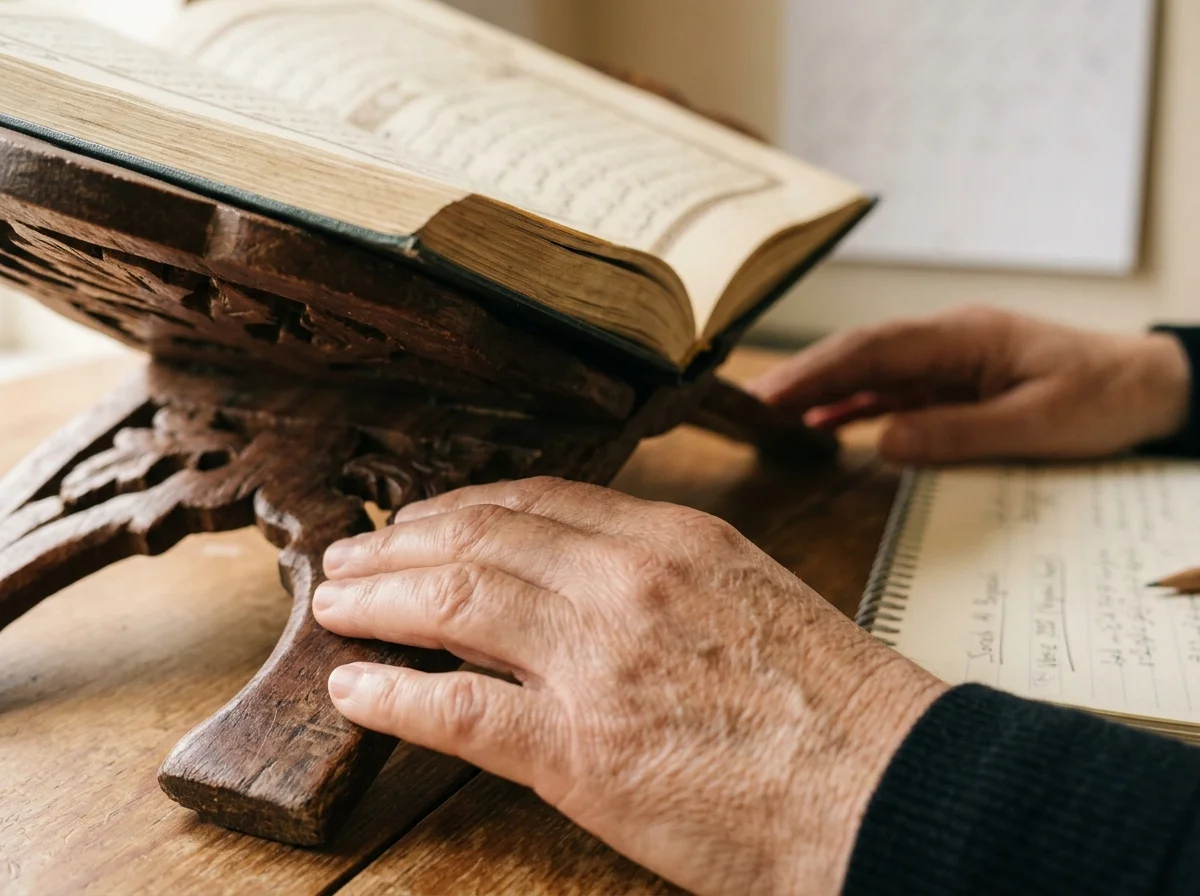
You do not need a special room. I used a corner of my bedroom with a small shelf, a cushion, and good lighting.
My simple setup:
- A clean, quiet spot away from the television
- A Quran stand so the book stays at eye level
- A notebook and pencil for noting difficult words
- Headphones for listening to recitation
- Phone on silent during my session
The stand mattered more than I expected. Holding the book low made my neck sore and cut my sessions short. Once I raised it, I could focus for longer.
Make wudu before you begin if you can. It is a small act, but it turns an ordinary moment into one that feels set apart.
Step 3: Build a Daily Routine That Fits Real Life
This is the heart of how I learned the Quran from home. The routine mattered far more than the method.
The 20-Minute Rule
I started with just 20 minutes a day. On busy days, I allowed myself to do 10. The rule was simple: never skip two days in a row.
Short daily sessions beat long weekly ones. A little each day keeps the sounds fresh in your mind and your tongue.
Choose a Fixed Time
I tied my practice to an existing habit, right after Fajr. Others prefer after Maghrib or before sleep. The best time is the one you can protect.
Ways to anchor your routine:
- Right after a daily prayer
- Right after your morning tea or coffee
- During a quiet window while the house is still
- Just before bed, when the day has slowed down
A Sample Daily Structure
| Minutes | Activity |
|---|---|
| 3 | Intention, wudu, and a short dua |
| 5 | Review yesterday’s reading |
| 10 | New reading with careful repetition |
| 2 | Note difficult words and close with dua |
This simple structure kept me from wandering. I always knew what came next.
Step 4: Learn the Arabic Letters and Sounds First
If you cannot yet read Arabic, this is where to begin. I spent my first weeks only on the 28 letters, their shapes at the beginning, middle, and end of a word, and the short vowel marks.
I did not rush into long passages. I wanted my eyes to recognize each letter without hesitation.
What I Practiced in the First Month
- Letter names and shapes until I could recognize them at a glance
- Short vowels (fathah, kasrah, dammah) and how they change a sound
- Joining letters into short syllables and simple words
- Reading slowly and out loud, never silently
Reading aloud mattered. When I only looked at the words, I fooled myself into thinking I knew them. Speaking them showed me exactly where I was weak.
Tip: Use a pencil to point at each letter as you read. It sounds childish, but it stopped me from skipping ahead.
Step 5: Use Listening and Repetition
Reading with my eyes was only half the picture. The Quran is a recited book, and hearing it correctly shaped my pronunciation more than any chart did.
I picked one respected reciter with a clear, steady pace and listened to the same passage several times before reading it myself. Then I read along, then read alone.
My Three-Pass Method
- Listen to the passage two or three times without reading
- Read along with the recitation, matching the pace
- Read alone, then compare with the audio
This loop helped me hear small errors I could not catch on my own. The Quran instructs us to recite in a measured, deliberate way (Surah Al-Muzzammil, 73:4), so I never raced through a page.
Why repetition works:
- It trains your ear and your tongue at the same time
- It builds fluency without needing to memorize rules first
- It turns difficult words into familiar ones over time
Also Read: Bedtime Quran Stories: 9 Gentle Tales and a Simple Routine to Calm Your Child’s Night
Step 6: Understand What You Read
Reading without meaning left me feeling disconnected. After a few weeks, I added a short reflection step to each session.
I read a trusted translation of the passage I had just recited, then one or two lines of explanation from a reliable commentary. I kept it short so it did not take over the whole session.
How I added understanding without overwhelm:
- Read the translation after the Arabic, never instead of it
- Pick one verse a day to think about deeply
- Write one practical lesson in my notebook
- Return to the same surah later and notice new details
This changed the experience. The Quran stopped being a task and became a conversation. On days my reading felt mechanical, a single verse was enough to bring my heart back.
Step 7: Track Your Progress
Progress at home can feel invisible, because no one is checking in on you. I solved this with a simple tracker.
I used a wall calendar and marked each day I completed my session with a tick. After two weeks, I did not want to break the chain.
What I tracked weekly:
- Pages or verses read
- Words I kept getting wrong
- Total minutes spent
- One thing I improved
On Fridays, I read a passage aloud to a family member or a trusted friend who could follow along in the Mushaf. Having another person listen helped me catch mistakes I could not hear myself, and it kept my pronunciation honest.
Mistakes I Made (So You Can Avoid Them)
I stumbled more than once. These were my biggest errors.
- Starting too big. I tried a full page on day one and burned out within a week.
- Skipping the basics. I rushed past letter sounds and paid for it later.
- Switching methods constantly. New apps and techniques felt exciting but broke my rhythm.
- Reading silently. I thought I was learning, but my pronunciation did not improve.
- Waiting for perfect conditions. The perfect time never arrived, and I lost months.
If you recognize yourself in any of these, do not be discouraged. Each one is easy to fix.
Common Challenges and How I Handled Them
When Motivation Drops
Every learner hits a flat week. On those days, I lowered the bar to just five minutes. Showing up, even briefly, protected the habit.
When Distractions Pull You Away
I put my phone in another room and told my family my 20-minute window was protected. Small boundaries made a huge difference.
When Pronunciation Feels Impossible
Some sounds in Arabic have no equivalent in other languages. I slowed down, listened to the reciter repeatedly, and practiced one sound for several days before moving on. Patience beats force.
When You Feel Embarrassed About Starting Late
Many adults begin later in life, and there is no shame in it. The hadith about the double reward for the one who struggles is a reminder that your effort is seen.
Key Takeaways: How to Learn the Quran from Home
- Start with sincere intention and a small, specific goal
- Use one Mushaf and a calm, dedicated space
- Commit to 20 minutes daily, and never miss two days in a row
- Master the letters and short vowels before long passages
- Listen, read along, then read alone for steady improvement
- Add translation and reflection to build a real connection
- Track your progress with a simple calendar
- Have someone trusted listen to you read now and then
Conclusion
Looking back, how I learned the Quran from home came down to a few humble choices: a sincere intention, a tiny daily routine, careful listening, and patience with myself. There was nothing dramatic about it, yet the results grew steadily.
If you have been waiting for the right moment, this is it. Open your Mushaf today, make your intention, and read for just a few minutes. Small, consistent steps are how the Quran becomes part of your life.
Sources and Official References
The Holy Quran
- Surah Al-Qamar (54:17): https://quran.com/54/17
- Surah Al-Muzzammil (73:4): https://quran.com/73/4
Sahih al-Bukhari
- Collection overview: https://sunnah.com/bukhari
- “The best among you are those who learn the Quran and teach it” (Hadith 5027): https://sunnah.com/bukhari:5027
- Double reward for the one who recites with difficulty (Hadith 4937): https://sunnah.com/bukhari:4937
Sahih Muslim
- Collection overview: https://sunnah.com/muslim
- Double reward for the one who recites with difficulty (Hadith 798): https://sunnah.com/muslim:798
Frequently Asked Questions
1. Can I really learn the Quran from home as a complete beginner?
Yes. I began with no confident reading ability and learned step by step at home. Start with the Arabic letters and short vowels, then move to short surahs. A steady daily routine matters more than prior experience.
2. How long does it take to learn to read the Quran at home?
It varies by person, time, and consistency. With around 20 minutes daily, many beginners become comfortable reading simple passages within a few months. Fluency across the whole Quran takes longer, so focus on steady improvement rather than a deadline.
3. What do I need to start learning the Quran from home?
You need a clear Mushaf, a quiet space, a notebook, and audio of a respected reciter. A Quran stand and a simple progress calendar help a lot. Most of these are inexpensive or already in your home.
4. How do I stay consistent when learning the Quran at home?
Tie your session to an existing habit, such as right after a daily prayer. Keep sessions short, never skip two days in a row, and track your progress visibly. On difficult days, reduce the time instead of quitting.
5. How can I check my pronunciation when learning the Quran from home?
Compare your reading with a clear recitation, using the listen, read along, read alone method. You can also recite occasionally to a trusted, knowledgeable person who can follow along in the Mushaf and point out errors.
Disclaimer: This article is provided for educational and informational purposes only and reflects general Islamic scholarly perspectives on Surah Yaseen. It is not a substitute for guidance from a qualified Islamic scholar or certified religious authority. For matters of hadith authenticity, personal practice, or specific religious rulings, please consult a certified professional in Islamic studies.
