Online Quran Classes for Preschoolers: A Parent’s Complete Guide to Early Islamic Learning
Online Quran Classes for Preschoolers
Why the Early Years Matter More Than You Think
A three-year-old who hums along to Surah Al-Fatiha isn’t just being cute. She’s building neural pathways that make Arabic sounds feel natural instead of foreign.
That’s the real promise behind online Quran classes for preschoolers. It’s not about early memorization pressure. It’s about planting seeds while the soil is softest.
Parents often assume Quran education should start once a child can read fluently. But child development research and centuries of Islamic tradition both point the other way. The preschool years, roughly ages 3 to 6, are when language acquisition happens fastest and most effortlessly.
This guide walks through what online Quran classes for preschoolers actually look like, how to evaluate them, and what realistic expectations should be for this age group.
What Are Online Quran Classes for Preschoolers?
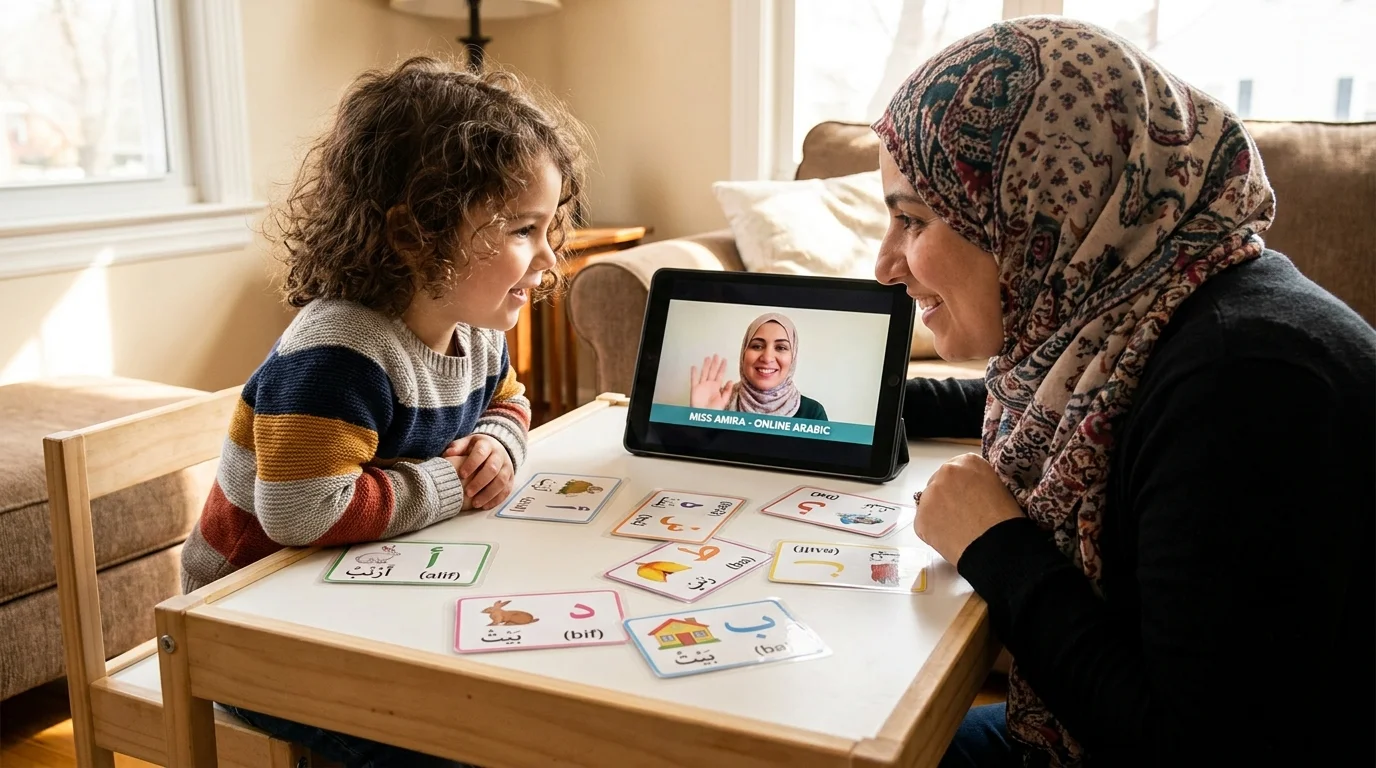
Online Quran classes for preschoolers are structured, age-appropriate sessions designed for children roughly between 3 and 6 years old. They’re delivered through video calls, typically one-on-one or in very small groups.
Unlike classes for older children, these sessions are built around short attention spans, playful repetition, and sensory engagement rather than formal reading instruction.
Key features usually include:
- Sessions lasting 15 to 25 minutes, not longer
- Heavy use of songs, rhymes, and visual aids
- Focus on short surahs, basic duas, and Arabic letter sounds
- Parent involvement encouraged, especially for very young children
- Frequent positive reinforcement rather than correction-heavy teaching
The goal at this stage isn’t fluency. It’s familiarity, love, and comfort with the Quran and Arabic sounds.
Why Preschool Age Is a Unique Window for Learning
The Brain Is Wired for Language Absorption
Children under six absorb new sounds and languages with far less effort than older learners. This is sometimes called the “critical period” for phonetic learning.
Arabic has sounds that don’t exist in English or many other languages. A preschooler’s ear can catch and reproduce these sounds more naturally than a ten-year-old’s can.
Habits Formed Early Tend to Stick
A child who associates Quran time with warmth, songs, and gentle attention is more likely to carry that positive association into later years. This emotional foundation often matters more long-term than early academic progress.
Short Attention Spans Aren’t a Barrier, They’re a Design Constraint
Good preschool Quran programs don’t fight against a child’s natural attention span. They work within it, using short bursts of engagement instead of long, seated instruction.
What a Typical Online Session Looks Like
Understanding the actual flow of a class helps parents set realistic expectations.
A well-structured session for this age group generally includes:
- A short greeting and warm-up, often with a familiar dua
- Repetition of a previously learned verse or letter sound
- Introduction of one new, small element (a sound, a word, a short ayah)
- A song, clapping rhythm, or visual game to reinforce the lesson
- A closing dua and praise for the child’s effort
Sessions rarely aim to “cover material” the way older-student classes do. Instead, they aim for repetition without boredom, which is genuinely difficult to design well.
Core Skills Preschoolers Actually Build
It helps to know what’s realistic to expect, since expectations set the tone for how parents perceive progress.
Arabic Letter Recognition
Not reading yet, but recognizing shapes and associating them with sounds. Think of it like learning the alphabet song before actually reading books.
Sound Discrimination
Learning to hear the difference between similar Arabic letters, such as ha and kha, or seen and saad. This early ear-training pays off significantly later.
Short Surah Memorization Through Repetition
Surahs like Al-Ikhlas, Al-Falaq, and An-Nas are commonly introduced through repeated listening and gentle mimicking, not formal memorization drills.
Basic Duas for Daily Life
Duas for eating, sleeping, and leaving the house are often woven into lessons because they connect directly to a child’s everyday experience.
Emotional Association With the Quran
Perhaps the most important, least measurable skill: the feeling that Quran time is safe, warm, and enjoyable.
How to Evaluate an Online Program for Your Preschooler
Not every online class labeled “for kids” is genuinely designed for prechool-age children. Here’s what to look for.
Instructor Experience With Young Children
Teaching a six-year-old is a completely different skill from teaching a teenager. Ask specifically whether the instructor has experience with the 3 to 6 age range, not just “kids” broadly.
Session Length and Structure
If a program offers 45-minute sessions for a four-year-old, that’s a red flag. Preschoolers typically can’t sustain focused attention that long, even with breaks.
Use of Visual and Audio Aids
Preschoolers learn through senses, not abstract explanation. Programs using colorful visuals, songs, and interactive elements tend to hold attention far better than lecture-style delivery.
Parent Involvement Expectations
Many effective programs for this age group expect a parent to sit nearby, especially in early sessions. This isn’t a weakness of the program. It’s developmentally appropriate.
Flexibility and Patience Built Into the Format
Preschoolers have off days. A good program builds in flexibility for rescheduling, shorter sessions when needed, and a non-punitive tone when a child is having a hard day.
Common Mistakes Parents Make at This Stage
Being aware of these pitfalls can save a lot of frustration.
- Expecting reading fluency too early. Recognition and sound familiarity come first; actual reading typically develops closer to age 6 or 7.
- Choosing overly long sessions. More time doesn’t equal more learning at this age; it often just leads to disengagement.
- Skipping repetition because it feels “too easy.” Repetition is exactly how preschoolers consolidate learning.
- Comparing progress to older siblings or other children. Every child’s pace with language absorption varies naturally.
- Treating early sessions as academic performance rather than relationship building. The tone set now shapes attitudes toward learning for years.
Setting Up a Supportive Learning Environment at Home
The online class is only part of the picture. What happens around it matters just as much.
A few practical habits that support progress:
- Keep a consistent time of day for sessions so it becomes part of the child’s routine
- Minimize background distractions during the call
- Celebrate small wins openly, even something as simple as recognizing one letter
- Avoid turning practice outside of class into pressure or drilling
- Let the child see a parent or older sibling engaging with the Quran too, since modeling matters enormously at this age
Also Read: Friendship in Islam: How to Choose Companions Who Strengthen Your Faith
Realistic Timeline: What Progress Looks Like Over a Year
Parents often ask what “normal” progress looks like. While every child differs, a general pattern tends to emerge over roughly 12 months of consistent, gentle sessions.
Months 1 to 3: Comfort with the routine, recognition of a few Arabic letters, familiarity with one or two short duas.
Months 4 to 6: Ability to recite Surah Al-Ikhlas or similar short surahs with prompting, growing letter recognition.
Months 7 to 9: More independent recitation of familiar surahs, better sound discrimination between similar letters.
Months 10 to 12: Noticeable confidence, a small but stable base of memorized short surahs and duas, genuine enjoyment of the routine.
This timeline isn’t a guarantee, but it reflects patterns commonly observed when sessions stay consistent and developmentally appropriate.
Key Takeaways
- Online Quran classes for preschoolers work best when built around short sessions, repetition, and sensory engagement rather than formal instruction.
- The preschool years offer a genuine developmental advantage for absorbing Arabic sounds.
- Emotional association with the Quran matters as much as measurable skill in these early years.
- Parent involvement, patience, and realistic expectations shape long-term outcomes more than any single curriculum choice.
Final Thoughts
Starting online Quran classes for preschoolers isn’t about racing toward memorization milestones. It’s about using a unique developmental window to build comfort, familiarity, and genuine affection for the Quran.
A child who giggles through a Surah An-Nas song at age four is quietly building something that formal lessons alone rarely achieve: a natural, joyful relationship with the Quran that can carry forward for a lifetime.
Sources and Official References
- Journal of Child Language, Cambridge University Press: https://www.cambridge.org/core/journals/journal-of-child-language
- American Academy of Pediatrics, “Media and Young Minds” policy statement: https://publications.aap.org/pediatrics/article/138/5/e20162591/60503/Media-and-Young-Minds
- “Al-Quran Based Learning in Early Childhood Education,” Atlantis Press: https://www.atlantis-press.com/article/125954489.pdf
FAQs?
Most educators recommend starting between ages 3 and 4, when children are naturally absorbing new sounds and language patterns most easily.
2. How long should an online Quran class be for a preschooler?
Sessions of 15 to 25 minutes work best, since younger children typically cannot sustain focused attention much longer than that.
3. Will my preschooler learn to read Arabic right away?
Not immediately. Preschool-stage classes focus on letter recognition and sound familiarity, with actual reading fluency developing closer to age 6 or 7.
4. Do parents need to be present during online Quran classes for preschoolers?
Yes, especially in early sessions. Parental presence helps young children feel secure and supports better engagement with the instructor.
5. What can a preschooler realistically memorize in the first year?
With consistent sessions, many preschoolers can comfortably recite a few short surahs, such as Al-Ikhlas, Al-Falaq, and An-Nas, along with basic daily duas.
If you wish to learn the Quran online or enroll in one of our Quran courses, click below and start your learning journey today.
Explore Our Courses →
