What a Good Quran Tutor Actually Does (And Why It Changes Everything)
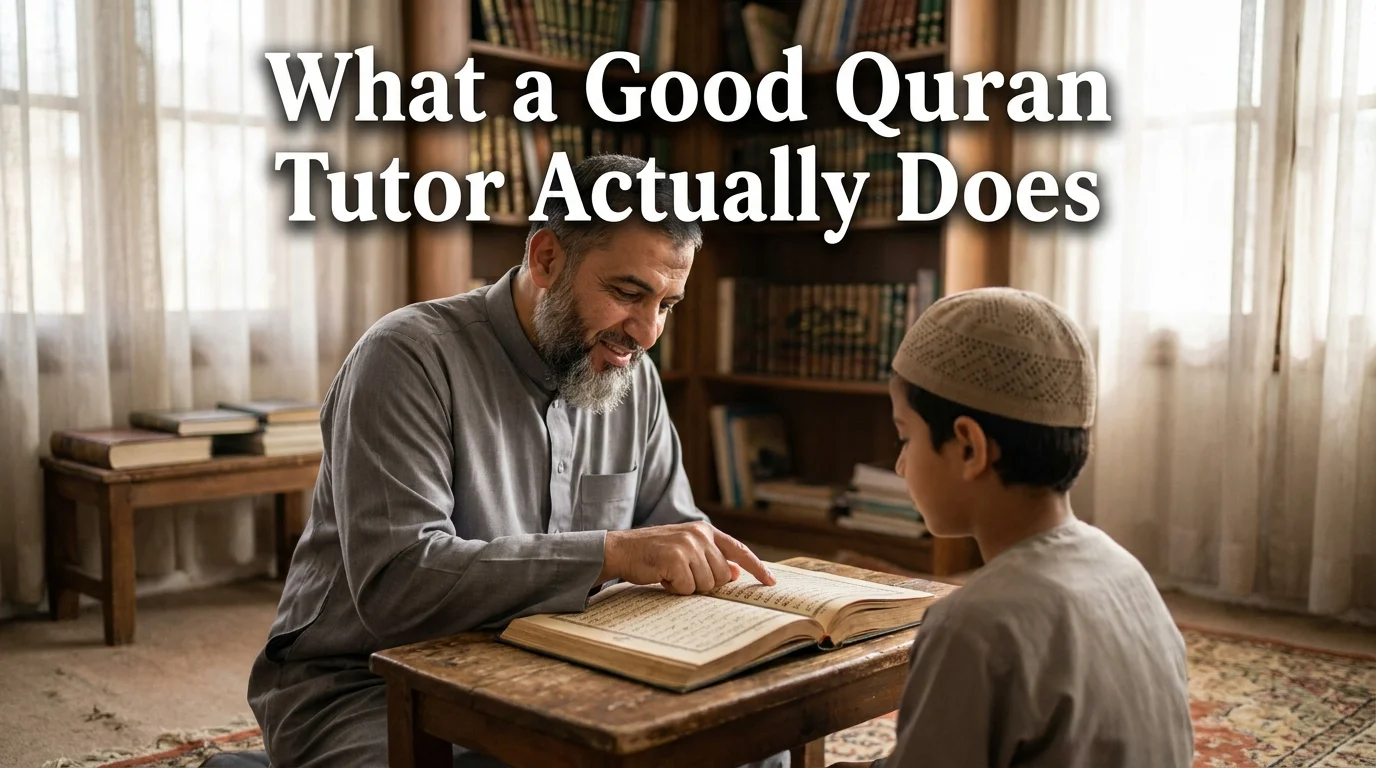
The Question Every Parent Asks Before the First Lesson
Before you hand over your child’s Quranic education to a stranger on a screen, you probably ask yourself one honest question: is this person actually going to teach, or just recite along while my child copies?
It is a fair question. Anyone can open a mushaf and read out loud. Teaching someone else to read it correctly, understand it, and love it is a completely different skill.
A good Quran tutor does far more than listen to recitation and nod. They diagnose pronunciation errors most people cannot even hear, build a memorization system that survives real life, and quietly shape a student’s relationship with the Quran for decades to come. This guide breaks down exactly what that work looks like, based on how qualified tutors actually structure their sessions, what credentials matter, and what separates a tutor worth paying for from one you should walk away from.
What Does a Good Quran Tutor Actually Do?
A good Quran tutor corrects Tajweed errors in real time, builds a structured memorization and revision plan, verifies pronunciation against a certified chain of transmission (Ijazah), and adapts teaching pace to the student’s age and ability. Their core job is accuracy first, retention second, and love for the Quran always.
That is the one-paragraph answer. Now let’s unpack what each piece actually involves, because the details are where most tutoring services quietly cut corners.
How Does a Quran Tutor Teach Tajweed Correctly?
Tajweed is not decoration. It is the set of pronunciation rules that determines whether a letter is articulated from the correct point in the mouth or throat (called makhraj), and whether it carries its correct characteristics (called sifat).
A competent tutor listens for specific, technical errors, not general fluency:
- Makhraj errors: swapping a heavy letter like qaaf for a lighter one like kaaf
- Madd errors: elongating a vowel for two counts instead of four, or the reverse
- Ghunnah errors: missing the nasal sound required on noon and meem when followed by certain letters
- Qalqalah errors: failing to produce the required “bounce” on letters like qaaf, taa, baa, jeem, and daal when they carry a sukoon
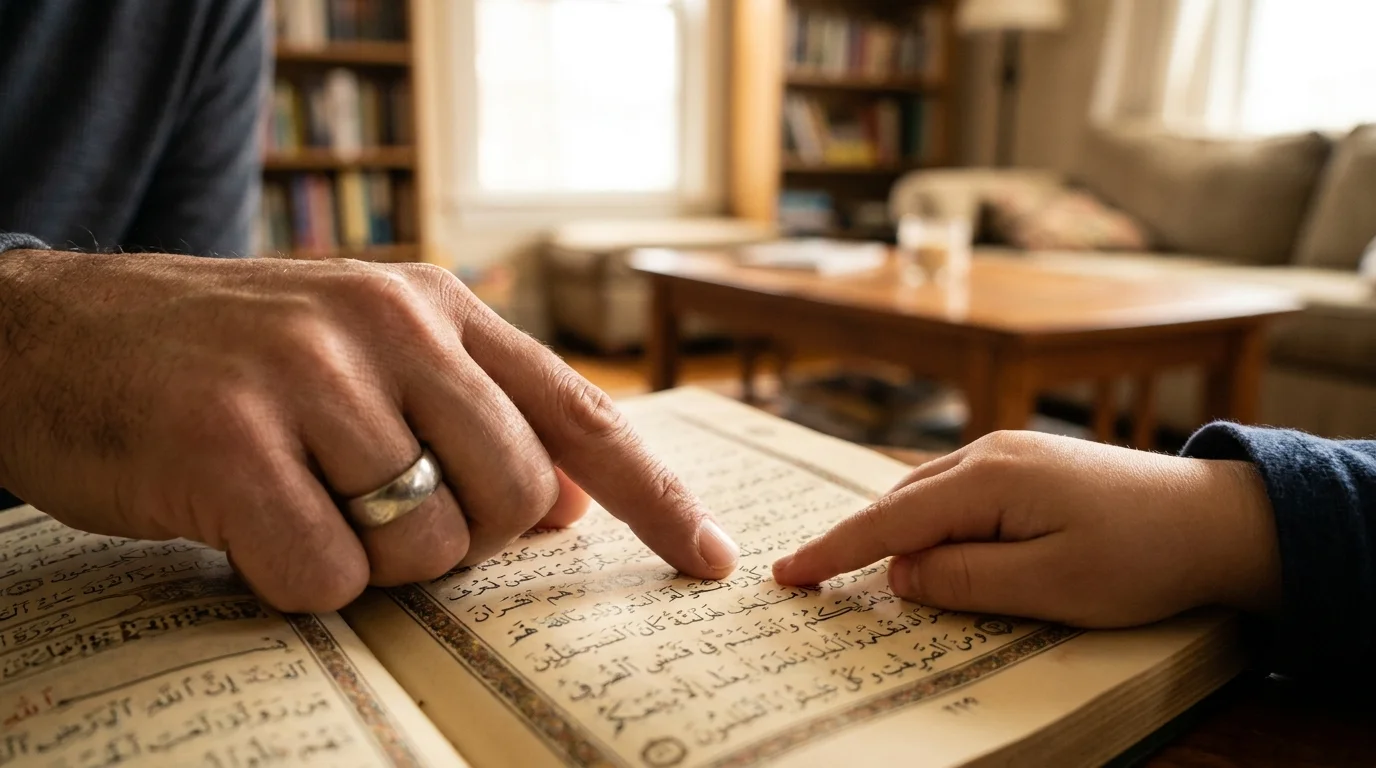
Here is something I have noticed after watching dozens of trial lessons across different platforms: the tutors who are actually good rarely let more than two or three words pass before gently stopping a student. Weak tutors let a student read an entire page uninterrupted, then say “good job” at the end. That single habit, correcting in the moment rather than after the fact, is usually the clearest tell of whether someone actually knows Tajweed or is simply reading along.
What Qualifications Should a Quran Tutor Have?
This is where families get misled most often. A fluent Arabic speaker is not automatically a qualified Quran tutor, and a hafiz (someone who has memorized the Quran) is not automatically qualified to teach Tajweed either. Memorization and pedagogy are separate skills.
The credential that actually matters is called an Ijazah. An Ijazah is a formal authorization granted by a certified teacher to a student who has recited the Quran to them accurately, confirming the student’s proficiency and linking them into an unbroken chain of transmission (called an isnad) that traces back through generations of scholars. This chain of transmission is the mechanism that has preserved the Quran’s recitation with such precision across roughly 1,400 years.
When vetting a tutor, ask directly:
- Do they hold an Ijazah in a specific recitation (commonly Hafs an Asim), and from which teacher or institution?
- Have they memorized the full Quran, or a portion, and can they verify it?
- Have they completed a structured Tajweed curriculum, not just informal family instruction?
- Do they have documented experience teaching children specifically, since teaching a seven-year-old requires completely different pacing than teaching an adult?
Why the Chain of Transmission Actually Matters
It is easy to dismiss the Ijazah system as ceremonial, but it functions as a quality control mechanism. A teacher cannot grant an Ijazah unless they themselves hold one, which means every certified Quran tutor sits inside a verifiable lineage rather than a self-declared claim of expertise. That accountability structure is precisely what has kept regional recitation differences (Hafs, Warsh, and others) consistent and traceable for over a millennium.
Why Does One-on-One Attention Matter in Quran Tutoring?
Group Quran classes have their place, but individual correction is where actual skill develops. In a group of ten students, a tutor might hear each child recite for ninety seconds in a thirty-minute class. That is not enough time to catch, correct, and reinforce a pronunciation habit before it becomes permanent.
Academic research backs this up in a broader sense. A 2020 literature review published through the International Journal of Academic Research in Progressive Education and Development examined memorization strategies including repetition, rehearsal, and chunking, and found that structured, individualized reinforcement consistently outperformed passive group repetition for long-term retention. In plain terms: a tutor who tailors the chunk size, review interval, and correction style to one specific student produces stronger memorization than one repeating the same pace across a whole classroom.
How Do Good Tutors Handle Different Learning Paces?
No two students memorize at the same speed, and a tutor who ignores that is setting a student up to quit. In my own observation of tutoring programs over the years, the students who burn out fastest are almost always the ones pushed to memorize a fixed number of lines per week regardless of how well those lines were actually retained.
A tutor who knows what they are doing typically:
- Runs a short diagnostic in the first one or two sessions to establish current reading level and memorization capacity
- Sets a realistic weekly target (often as little as a quarter or half a page for beginners) rather than a generic pace
- Builds in structured revision cycles (daily, weekly, and monthly review) rather than only moving forward
- Adjusts homework load around exams, travel, or a child simply having a rough week
What Does a Typical Quran Tutoring Session Actually Look Like?
A well-run session usually follows a consistent rhythm, and once you have sat through a few, the pattern becomes obvious:
- Warm-up recitation of previously memorized material (revision comes first, almost always)
- New material introduction, broken into small, manageable chunks
- Real-time correction of Tajweed as the student reads, not saved for the end
- Repetition drills where the student repeats a corrected word or phrase multiple times until it sticks
- Homework assignment with a specific, measurable target for the next session
If a session skips step three (correcting in the moment) or step five (a specific homework target), that is usually a sign the tutor is coasting rather than actually teaching.
Actionable Tips: How to Choose the Right Quran Tutor
Finding a reliable Quran tutor takes more than reading star ratings. Here is a practical checklist:
- Request a trial lesson and pay attention to how often they interrupt to correct, not how warmly they praise
- Ask for their Ijazah chain (who certified them, and in which recitation) rather than accepting a vague claim of qualification
- Confirm their experience with your child’s age group, since a tutor excellent with teenagers may struggle with a distracted five-year-old
- Check their revision structure, since a tutor with no clear plan for reviewing old material will produce forgotten memorization within months
- Observe their patience under repetition, because a student needing the same correction eight times is normal, not a discipline problem
- Verify session consistency, since irregular scheduling is one of the strongest predictors of memorization loss
What Mistakes Do Poor Quran Tutors Make?
Watch for these red flags, all of which I have personally seen in trial sessions that looked fine on the surface but fell apart within a month:
- Letting a student read pages of text without a single correction
- Assigning memorization targets with no accompanying revision schedule
- Focusing entirely on speed of completion rather than accuracy of pronunciation
- Treating every student identically regardless of age, pace, or prior exposure
- Being unable to explain, when asked directly, which specific Tajweed rule a student is violating
What Research Says About Quran Memorization and Learning
Beyond anecdotal teaching experience, there is a growing body of academic research on how structured Quran instruction affects learners. A 2025 study published in the Islamic Guidance and Counseling Journal followed four hundred adult women across five levels of Quran memorization, from minimal to complete, and found that consistent attendance at structured memorization programs predicted life satisfaction more strongly than general happiness or raw cognitive test scores.
Separately, a review published through the International Education Journal categorized the effects of Quran memorization into cognitive, metacognitive, and psychological outcomes, noting measurable improvements in memory strategy use and self-monitoring among consistent students. None of this happens automatically. It happens because a structured teacher, applying structured methods, guided the process. That is the actual value a Quran tutor brings that self-study cannot replicate: correction, structure, and accountability applied consistently over time.
Final Thoughts
A good Quran tutor is part linguist, part memory coach, and part mentor. They catch a mispronounced letter before it becomes a lifelong habit, they build a revision system that actually holds up months later, and they carry the responsibility of an unbroken teaching chain seriously enough to keep earning it every single session. If you remember one thing from this guide, let it be this: the quality of a Quran tutor is measured far more by how often they correct you than by how encouraging they sound.
Also Read: How to Choose an Online Quran Tutor
Frequently Asked Questions
How much does a Quran tutor typically cost per month?
Rates vary widely by qualification and platform, but most certified one-on-one Quran tutors charge between 60 and 150 US dollars per month for two to three weekly sessions. Group sessions or less credentialed tutors can run lower, though quality and correction frequency usually drop as well.
How do I know if my Quran tutor is actually qualified?
Ask them directly for their Ijazah details, including which teacher or institution certified them and in which recitation (commonly Hafs an Asim). A qualified tutor will answer this specifically and without hesitation, since it is a verifiable credential, not a vague claim.
What age should a child start learning with a Quran tutor?
Most structured programs begin formal one-on-one tutoring around age five or six, once a child can sit through a short focused session. Earlier exposure through listening and simple recitation is fine, but structured Tajweed correction generally starts once basic Arabic letter recognition is in place.
Can online Quran tutors be as effective as in-person ones?
Yes, when the tutor is genuinely qualified and the session includes real-time audio correction, screen sharing of the mushaf, and consistent scheduling. The delivery method matters far less than whether the tutor is actively correcting pronunciation in the moment rather than passively listening.
How long does it take to memorize the full Quran with a tutor?
With consistent daily practice and a structured tutor, most students complete full memorization (hifz) in three to five years, though this varies heavily based on age, daily time commitment, and how much revision is built into the schedule. Slower, well-revised memorization tends to be far more durable than rushed pacing.
Sources and Official References
Alnajashi, S. A., Al Qasem, M. A., Al-Mishaal, K. A., & Aluthman, W. A. E. (2025). The Impact of Attending Qur’an Memorization Programs on Psychological Wellbeing: A Study on Adult Females. Islamic Guidance and Counseling Journal, 8(2). https://doi.org/10.25217/0020258594900
Educational Strategies on Memorizing the Quran: A Review of Literature. International Journal of Academic Research in Progressive Education and Development, HRMARS (2020). https://hrmars.com/papers_submitted/7649/educational-strategies-on-memorizing-the-quran-a-review-of-literature.pdf
Cognitive, Metacognitive, and Psychological Consequences of Quran Memorization: A Systematic Review. International Education Journal. https://iej.ihu.ac.ir/article_208404_52952748a3d55a00d1f39d1296caecef.pdf
What is Ijazah Quran? Certification for Mastering Quran Recitation. Ulum Al-Azhar. https://ulumalazhar.com/?p=29417
Disclaimer: This article is provided for general educational and informational purposes only. It does not constitute religious, academic, or professional advice. Always consult a certified Quran teacher, Islamic scholar, or accredited educational institution for guidance specific to your or your child’s learning needs.
