What Is Zamzam Water? The Miraculous Story Behind Islam’s Holiest Spring
What Is Zamzam Water?
The Well That Has Never Run Dry in 4,000 Years
Picture a desert valley with no rivers, no rainfall, and no shade. Now picture a spring bursting out of that same dry ground and flowing, without interruption, for over four thousand years.
That is Zamzam.
I have spent years studying Islamic history and guiding students through the stories behind our sacred sites, and Zamzam always sparks the same question in class: is this just a legend, or is there something real and measurable behind it? The honest answer is both. The story is rooted in deep faith, and the water itself has been tested, measured, and documented by modern science.
In this guide, we will walk through where Zamzam comes from, why it matters so much to Muslims, what the research actually says about it, and how it reaches the hands of pilgrims today.
What Is Zamzam Water, Exactly?
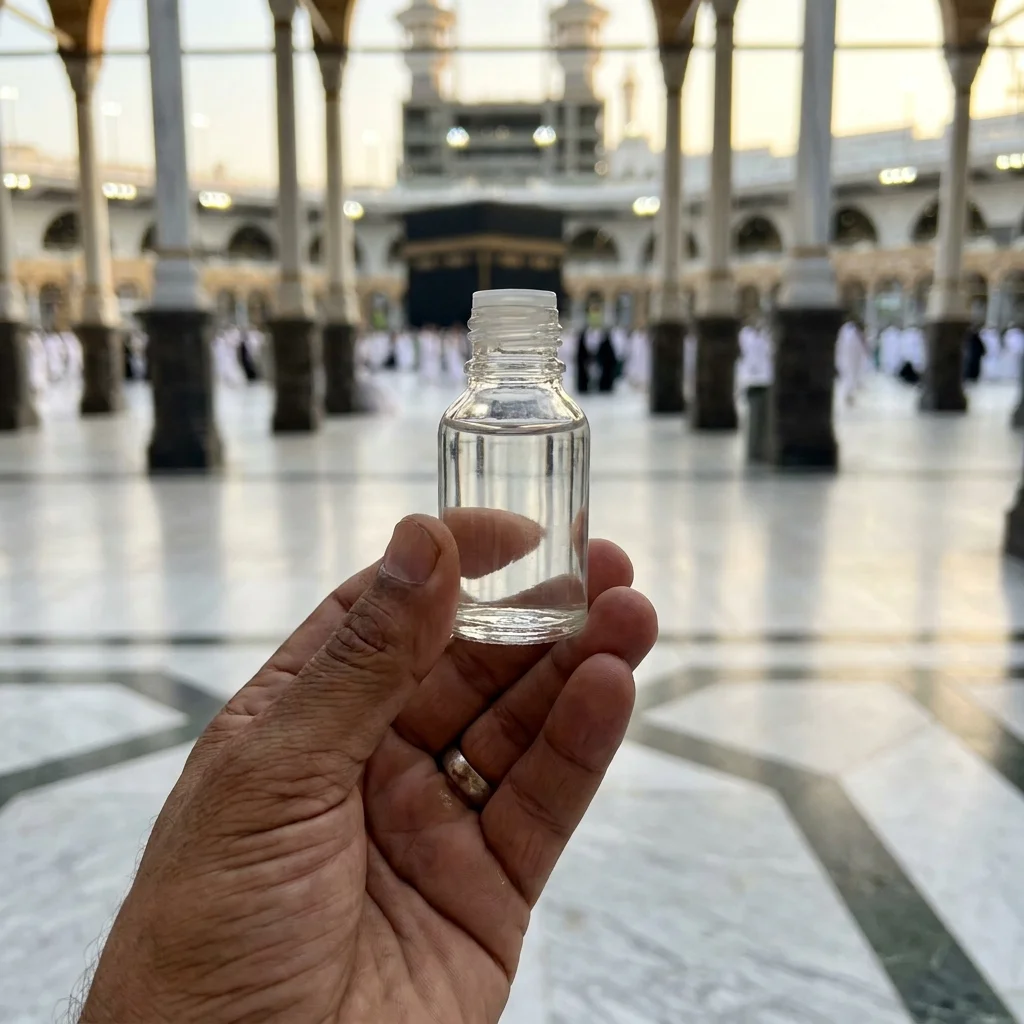
Zamzam water is the water drawn from the Zamzam Well, located inside the Masjid al-Haram (the Grand Mosque) in Mecca, Saudi Arabia. The well sits about 21 meters east of the Kaaba, the holiest site in Islam.
For Muslims, this is not just groundwater. It is considered a blessed gift from Allah, tied directly to a story of faith, thirst, and divine mercy that every pilgrim retraces during Hajj and Umrah.
The well itself is roughly 30.5 meters deep, and it draws from an aquifer fed by underground channels connected to the surrounding mountains, including Mount Abu Qubais.
The Origin Story: Hajar, Ismail, and a Miracle in the Sand
To understand Zamzam, you have to go back to the story of Prophet Ibrahim (Abraham), his wife Hajar, and their infant son Ismail.
According to Islamic tradition, Ibrahim left Hajar and baby Ismail in the barren valley of Mecca on Allah’s command, with only a small amount of water and dates. Once those provisions ran out, Ismail grew thirsty and began to cry.
Hajar panicked and started searching for help. She ran back and forth between two nearby hills, Safa and Marwah, seven times, desperately looking for water or any sign of people.
On her final return, she found water gushing from the ground near her son. In one version of the story, it appeared when infant Ismail struck the earth with his heel. In another, the angel Jibreel (Gabriel) touched the ground and the spring appeared.
Hajar tried to contain the flowing water by calling out “Zomi, zomi” (meaning “stop, stop”), and this is widely believed to be the origin of the name Zamzam.
This same journey between Safa and Marwah is why Sa’i, the ritual of walking between these two hills, is a required part of both Hajj and Umrah today. Every pilgrim who performs Sa’i is physically retracing Hajar’s search for water.
A Detail Students Often Miss
When I teach this story, I always point out something people overlook: the well did not just appear once and stay static. Historical accounts describe it being buried under sand at points in history and later rediscovered, most notably by Abdul Muttalib, the grandfather of Prophet Muhammad (peace be upon him). He was later granted custodianship of the well, a responsibility that eventually passed to his son Al-Abbas.
This detail matters because it shows that Zamzam’s story is not only a one-time miracle. It is a well that has been protected, maintained, and passed down through generations for millennia.
Why Zamzam Water Matters So Much in Islam
Zamzam holds a unique place in Islamic practice for a few clear reasons.
It is directly tied to Hajj and Umrah rituals. Drinking Zamzam water is one of the recommended acts during pilgrimage, and pilgrims often drink it while facing the Kaaba.
The Prophet Muhammad spoke about it directly. He described Zamzam as blessed water, and Islamic tradition holds that it serves whatever intention or purpose a person drinks it for, whether that is healing, guidance, or gratitude. This is why many Muslims make a specific dua (supplication) before drinking it.
It connects Muslims to a shared act of worship. Millions of people from different countries, languages, and backgrounds drink from the same source every year. That shared experience carries real spiritual weight.
It is treated with respect, not casualness. Traditionally, Zamzam is sipped rather than gulped, and many Muslims try to drink it while standing and facing the Kaaba, following the example attributed to the Prophet.
What Does Science Actually Say About Zamzam Water?
This is where I always tell students to slow down and separate two things: religious belief and scientific measurement. Both can be true at once, but they are not the same claim.
Multiple peer-reviewed studies have analyzed Zamzam’s mineral and chemical makeup. Research published in the journal ScienceDirect used advanced laboratory testing (Inductively Coupled Plasma Mass Spectrometry) on Zamzam samples and found it to be a mineral rich water, containing notable levels of magnesium, calcium, sodium, and lithium, along with only trace, well below hazardous levels, of substances like aluminum, lead, arsenic, cadmium, and mercury.
That same body of research concluded that Zamzam water appears safe for regular drinking, with no evidence in the studies reviewed of harmful effects on the liver or kidneys. Researchers have also linked the water’s naturally alkaline pH to the granite rock formations that make up the surrounding aquifer, a finding consistent with data referenced by the Saudi Geological Survey.
Here is the part I always stress to students and readers alike: science can confirm what is physically in the water. It cannot confirm or deny spiritual healing. Those are two separate questions, and a good student of Islamic studies should never blur them together to make either science or faith look stronger than it is.
If you want the technical side of things, the Saudi Geological Survey has an entire research division, the Zamzam Studies and Research Centre, dedicated to ongoing water quality testing. You can review some of their referenced findings through the official Saudi Geological Survey documentation.
Common Health Claims, and What to Keep in Mind
People often ask me if Zamzam “cures” illness. Here is how I answer it honestly, every time:
- Many Muslims drink Zamzam with the intention of healing, following the Prophet’s description of the water.
- Scientific studies have confirmed safe mineral content and low levels of contaminants.
- Scientific studies have not established Zamzam as a treatment for specific diseases, and no credible medical body treats it as a substitute for medical care.
- The value for many believers is a combination of physical purity and spiritual intention, not a clinical guarantee.
If a student ever tells me they are relying on Zamzam instead of seeing a doctor, I always redirect them gently. Faith and medical treatment are not competitors. They work alongside each other.
Also Read: Mahr in Islam: Understanding the Concept and Its Significance
Where Does Zamzam Water Come From Today?
The well itself has not moved. It still sits in the same spot near the Kaaba, drawing from the same aquifer system it always has.
What has changed dramatically is how the water gets from the well to a pilgrim’s hand.
Two large pumps extract Zamzam water directly from the well at a rate of around 360 cubic meters per hour. From there, the water travels through a modern system for purification, filtration, and UV sterilization before it ever reaches a bottle or a public tap.
The King Abdullah bin Abdulaziz Zamzam Water Project
This is the facility responsible for almost everything a modern pilgrim experiences when they drink Zamzam.
Located in the Kudai area of Makkah, the project was built at a significant cost and uses advanced global technologies to purify and bottle Zamzam water without altering its natural properties. It currently operates with a production capacity exceeding 200,000 bottles per day.
The process generally works like this:
- Water is pumped from the well through stainless steel pipelines.
- It passes through filtration and UV sterilization to remove any biological contaminants.
- It is stored in large holding tanks.
- It is distributed through an automated network to taps inside the Grand Mosque, public dispensers, and official bottling lines.
You can explore more detail on this process through the official Discover Makkah government portal, which documents the facility and its role for visitors.
How Zamzam Reaches Pilgrims and Travelers
During Hajj season, distribution scales up massively. Reports have noted tens of millions of bottles distributed daily during peak pilgrimage periods, supported by automated dispensing systems, including robotic dispensers used to speed up distribution at crowded sites.
For everyday visitors and pilgrims outside of peak season, Zamzam is available in a few main ways:
- Free dispensers and coolers placed throughout the Grand Mosque and Prophet’s Mosque in Madinah.
- Official 5-liter bottles, factory sealed, available at designated collection points and hypermarkets.
- Airport counters, where pilgrims can typically purchase or collect one sealed 5-liter bottle to take home, subject to airline and terminal rules.
An Important Rule Most People Don’t Know
Here is something that surprises a lot of my students: Saudi Arabia does not permit unofficial commercial export of Zamzam water. Published research on the topic has specifically noted that the Saudi government has prohibited commercial export of the water, which is part of why authorities are strict about only recognizing sealed, factory-bottled containers from the official project. Hand-filled bottles are typically rejected at airport security, precisely because there is no way to verify their source or purity outside the official system.
If you are traveling and someone offers you an unofficial bottle of “Zamzam” being resold outside proper channels, treat it with real skepticism. The safest and most respected source is always the official project itself.
Practical Tips for Pilgrims and Travelers
After years of fielding questions from students preparing for their first Hajj or Umrah, these are the points I repeat most often.
Bring only official, sealed bottles home. Airport staff will not accept containers filled by hand, no matter how well-intentioned the source.
Check your airline’s specific rules before you travel. Some terminals only permit Umrah visa holders to carry Zamzam bottles, while others allow all travelers. Rules can also differ for checked versus carry-on luggage.
Drink with intention, not just habit. Many scholars recommend making a sincere dua before drinking, since tradition holds the water serves whatever purpose it is consumed for.
Do not treat it as medical treatment. Use it as a spiritual practice alongside, not instead of, proper healthcare.
Respect the one-bottle limit at official counters. This exists so the system can keep serving millions of pilgrims fairly, not to inconvenience individual travelers.
A Story I Often Share With Students
One of my students once asked me why, if the well is thousands of years old and constantly drawn from by millions of people every year, it has never dried up. I told her honestly: nobody has a purely mechanical answer for that. Hydrogeologists can explain the aquifer system and recharge rates. But for believers, the continuity of Zamzam is itself part of what makes it meaningful. It is a story that blends measurable science with something that history simply has not been able to fully explain away.
That, to me, is the real lesson of Zamzam. It rewards both the person who wants hard data and the person who wants faith. It does not ask you to choose one over the other.
Final Thoughts
Zamzam water sits at a rare intersection of history, faith, and modern engineering. It began with a mother’s desperate search for water for her thirsty child. It became a ritual tied to one of Islam’s most important acts of worship. And today, it reaches millions of people every year through one of the most carefully managed water distribution systems in the world.
Whether you approach it as a pilgrim, a student of Islamic history, or simply someone curious about the science, Zamzam remains one of the most well-documented and deeply meaningful water sources on earth.
Sources and Official References
- Saudi Geological Survey, Zamzam Studies and Research Centre: https://www.sgs.org.sa
- Discover Makkah (Official Saudi Government Portal), King Abdullah Zamzam Water Project: https://www.discovermakkah.sa/en/places-worth-visiting/landmarks/king-abdullah-zamzam-water-project
- ScienceDirect, “Metallic profile of Zamzam water: Determination of minerals, metals and metalloids by ICP-MS”: https://www.sciencedirect.com/science/article/pii/S2773050622000301
- ScienceDirect, “Zamzam water: Concentration of trace elements and other characteristics”: https://www.sciencedirect.com/science/article/abs/pii/S0045653511011787
- Arab News, “Centuries of serving Zamzam to pilgrims”: https://www.arabnews.com/node/2644981/saudi-arabia
Frequently Asked Questions
1. Where exactly is the Zamzam well located?
The Zamzam well is inside the Masjid al-Haram (Grand Mosque) in Mecca, Saudi Arabia, about 21 meters east of the Kaaba. It is roughly 30.5 meters deep.
2. Can non-Muslims drink Zamzam water?
There is no religious restriction against non-Muslims drinking Zamzam water. It is generally treated as a courtesy offered to all visitors of the Grand Mosque, though it is most closely tied to Muslim religious practice.
3. Is it legal to buy Zamzam water outside Saudi Arabia?
Saudi Arabia prohibits unofficial commercial export of Zamzam water. Any Zamzam sold abroad should be traceable back to the official King Abdullah bin Abdulaziz Zamzam Water Project, since unauthorized resale cannot be verified for authenticity or purity.
4. How much Zamzam water can a pilgrim take home?
Most airports allow one official, factory sealed 5-liter bottle per pilgrim, though specific rules can vary by terminal, airline, and visa type. Hand-filled containers are typically not accepted.
5. Does Zamzam water expire or need special storage?
Officially bottled Zamzam water is treated like standard purified drinking water regarding storage. It should be kept sealed, stored away from direct sunlight, and used within the timeframe indicated on its official packaging.
If you wish to learn the Quran online or enroll in one of our Quran courses, click below and start your learning journey today.
Explore Our Courses →
